AmeriCorps*VISTAs Blog on Grad School for Idealist.org

A former AmeriCorps*VISTA Leader and a current AmeriCorps*VISTA participate in Idealist.org’s Grad School Blog Project

Officially launched this week, a network of 12 bloggers — students, seekers, and admissions staff — are blogging about grad school. The project is a part of Idealist’s Public Service Graduate Education Resource Center.

Vanessa Mason is a prospective public health student and is a current AmeriCorps*VISTA member servingvanessa-mason with a refugee-focused nonprofit in Houston. She blogged about the relationship between refugees and public health this week as part of the refugee-themed Bloggers United day:

…Since I have started working as an AmeriCorps VISTA for the Partnership for the Advancement and Immersion of Refugees, this has taken on a newfound importance for me to raise awareness about the challenges that refugees face. This cause is particularly personal after meeting some of the children that have been directly affected by the escalating crisis in the Democratic Republic of Congo. Violence in recent weeks has escalated to an untenable level. While violence is an obvious contributor to the high mortality rates, the majority of deaths are caused by preventable and treatable diseases. (Read more…)

Vanessa blogs at Subject to Change. You can also follow her on Twitter.

Eileen Gallagher is a Masters candidate at Brandeis Heller School for Social Policy and Management. After graduating from college, she served as a VISTA on campus, “working with students to plan service events, running a tutoring program in local elementary schools and functioning as part of the college’s student affairs staff.”

Originally interested in higher ed administration, her experience in VISTA shifted her career goals.

She says, “I knew that I loved the community that I had built ineileen-gallagher small-town Meadville and the way that I saw people banding together to create change. I wanted to study ways to use the resources that a community has to create change.”

So, she says:

“I narrowed my interests to the fields of community development, nonprofit management or business. I decided that a business degree would allow me to gain the management and technical skills that I was interested in, as well as experience in leadership and organizational behavior. I looked specifically for programs that had coursework or a concentration in community development or socially responsible business.  I also examined the list of schools that match the AmeriCorps education award.

This list is precisely how I found Brandeis’ Heller School, where I am currently enrolled in the Master of Business Administration program.  When I looked at the website for this program, I saw that Heller’s motto is ‘Managing for a Social Mission.’  I was hooked!  This seemed like the perfect fit for my interests and ambitions.”

Eileen blogs for Social Impact MBA.

Read more about the Grad School Blog Project. Find more grad school bloggers and check out Idealist’s Public Service Graduate Education Resource Center. Apply to be part of the project—we are especially looking for bloggers in the fields of journalism, public interest law, public policy and administration, international affairs, and theology. The Project would also love to hear from more men!

Peace Corps China – Teaching future teachers

Volunteers teach college-level English in China’s interior for two years, including a summer of intense training. Livable monthly stipend, top-notch health benefits, Mandarin language education, network of other volunteers throughout the Southwest.

Peace Corps’s China program is one of my alma maters, and is a recruitment priority right now for Peace Corps. So I am sneaking it in as part of this week’s focus on teaching corps. Read about Peace Corps’s education programs more broadly.

Next week (Nov. 8th) my friend and China RPCV Kate Kuykendall, a public affairs specialist for the L.A. recruitment office, will host an Online Info Session about Peace Corps China that you can tune into for even more information.

A word about teaching English

The notion of teaching English doesn’t seem as glam as other overseas volunteer assignments like business or public health.

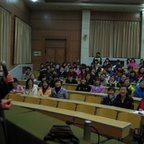
Chinese lecture hall, by Alison

Chinese lecture hall, by Alison

But English is a skill that people from the United States tend to have, and that other countries want for their youth. If you are looking to contribute to the development of other countries and build the capacity of young people there, English is a skill you can export and feel good about.

The other thing about teaching English is that right from the start of your term, before you can speak well in their language, your students can serve as insightful cultural informants to help you navigate your new life. Read about teaching English in China with Peace Corps.

Pre-service training

Trainees in the China program live in homestays during the two months of pre-service training, learn how to effectively teach English to large groups of students, study Chinese language in small groups with exceptional teachers, learn how to stay healthy (i.e., don’t drink unboiled water, what to do in case of unmentionable stomach ailments, etc.), receive scheduled immunization shots, and at the end of the summer, are sworn in as Peace Corps Volunteers.

Placement

Volunteers serve in teachers colleges in the interior of China, and teach classes of 40-60 students at a time.

English library, photo by Alison

English library, photo by Alison

Subjects  include English literacy, conversation, and  British and U.S. literature and culture.  The work week includes several courses, office hours, and often a teacher-hazing ritual called “English Corner.” Students typically come from very poor, rural areas, with plans to return home to teach English at the middle-school level. Colleges in China are more likely to be in cities, so China placements tend to be urban, where Volunteers live rent-free in modestly furnished campus apartments. Read some basics about living in China.

Benefits

A large Chinese kitchen, photo by Alison

A large Chinese kitchen, photo by Alison

Benefits of Peace Corps service — other than that your understanding of the world is enriched forever — include airfare to and from your country of service, health care (including prescription and over the counter medicines, yearly exams, evacuation home if the medical attention you need is not available in-country), a monthly stipend that is on par with that of locals, two vacation days per month (plus local holidays and weekends), reimbursement and per diem for all service-related travel, and just over $6,000 disbursed to you when your term of service ends.

If natural disaster, political unrest, plague, etc. make your stay in China untenable, Peace Corps will evacuate you and your group. Read more about the recent closing of the Bolivia program. In 2003, the Peace Corps China program was completely emptied out in response to the SARS epidemic.

In addition to pre-service language training, Peace Corps reimburses you the expense of on-going private language instruction once you are at your service placement. A few times a year you have the opportunity to head to trainings at Peace Corps country headquarters (in China, this is located in Chengdu, Sichuan, very near the May earthquake epicenter).

heping dui, photo by Alison

heping dui, photo by Alison

Educational benefits include deferring qualified student loans during your term of service (and partial cancellation of Perkins loans). Once you are back, you are eligible to apply for special fellowships at grad schools through the Fellows USA program, especially designed for Returned Peace Corps Volunteers (RPCVs). (For people who have not yet joined Peace Corps, also consider Peace Corps Masters International, which allows you to do Peace Corps service as part of a master’s degree). Read more and listen to a podcast on Peace Corps and grad school.

Peace Corps China journalists

No discussion of Peace Corps’s China program would be complete without mentioning the journalists who have graduated from it. While most China RPCVs have gone on to do great things in many fields, the group has produced several noteworthy writers and journalists.

Pete and a Chinese man, photo by Mark Leong

Pete and a Chinese man, photo by Mark Leong

These men’s voices weigh in on our understanding of China. They are helping people in the U.S. create a new consciousness of China, about the complexities of its culture, its conflicting priorities as it develops. The value of their contribution lies in their knowledge of the language, people, and context of China with a depth the U.S. reader hasn’t seen since missionary-era writers like Pearl Buck.

The emphasis Peace Corps China has traditionally placed on friendship (the Chinese name for the group is the Sino-U.S. Friendship Volunteers), cross-cultural and cross-linguistic understanding, produces a wider lens through which to view the nation and its billion-plus people — a lens some other journalists in China simply haven’t had.

It’s not that these journalists are apologists for the unsavory things the Chinese government does. But we aren’t going to learn anything about China, or any country, if we look only at the actions of a government and never at the people themselves… If we only listen to press conferences and never to the voices of the farmer or factory worker.

Multimedia

The independent Peace Corps Wiki is an alternative source of information about Peace Corps. Here’s the China wiki.

Read the online journal entries of Michelle Ross who served in China from 2006-08, and listings of other Peace Corps China blogs.

Check out this Google presentation featuring China RPCV Pete Hessler speaking about his writing and experiences in Peace Corps.

Check out the official Peace Corps Video Vault, where Volunteers speak to some of the most frequently-asked questions Peace Corps applicants have.

Resources

And a repeat: Next week (11/8) my friend and China RPCV Kate Kuykendall, a public affairs specialist for the L.A. recruitment office, will host an Online Info Session about Peace Corps China that you can tune into for even more information.

For more resources on graduate education, check out the Idealist.org Public Service Graduate Education Resource Center, and if you live in the vicinity of Georgia, come to our final graduate admissions fair coming to Atlanta on Monday, 11/3.

This week The New Service blog is looking at education service corps. While many service corps programs have application due dates in the spring for a fall start date, most education service corps have deadlines throughout the winter and start in the summer. Check out this list of education-related opprotunities that don’t require an education degree.

NYC Teaching Fellows

New teachers primarily work in Bronx and Brooklyn schools with high demand for faculty, covering subjects that are also desperately needed. Within two to three years, Fellows earn a subsidized Masters degree from university in the area.

NYC Teaching Fellows — as with Teach For America, Inner-City Teaching Corps, Mississippi Teacher Corps, and other education corps we are looking at this week — is designed to bring new talent to schools.

Eligibility

People who enter the program don’t need to have had any formal background in education, but do need to have a 3.0 Grade Point Average in undergraduate course work. Read about other eligibility requirements.

The program recruits both recent college grads as well as career changers.

Training and “placement”

After an intense June seven-week pre-service training, Fellows start teaching. The program assigns each Fellow the New York City borough in which they will teach, and their subject. (Of particular need are math and science teachers.)

Fellows research and apply for the teaching positions themselves, and are granted a provisional state teaching license for their time in the program.

While teaching, Fellows earn the salary and benefits of starting teachers in the city (salary nears $46,000).

Master’s degree

Each semester, Fellows take two courses towards their master’s degree, mostly paid for by the New York City Department of Education. (Over the course of the program, Fellows contribute almost $7,000 towards the cost of the mastser’s degree, and that is deducted from their pay checks.)

The specific universities and degrees vary for each Fellow, depending on the borough where they work, and the subject they teach. More than half attend City University of New York (CUNY) schools. For most Fellows, it takes two to three years to finish the degree. After that, NYC Teaching Fellows encourages graduating Fellows to stay in the city and continue teaching. They cite a statistic I’ve seen elsewhere that it takes about five years for a new teacher to really hit their stride, and they want all their Fellows to reach that point.

Multimedia

Browse profiles and videos of Fellows, including Travis Brown’s. Read the blog of Bill King, third-year Fellow teaching biology and physics.

Also, watch interviews with first-year Fellow Kristen Bloomer and take a look inside Fellow Jeanine Tubiolo’s classroom:

Finally, watch this online presentation about the NYC Teaching Fellows.

Deadlines and application

Upcoming deadlines to apply for a 2009 Fellowship are December 5 and January 5. Read more about the application process.

Resources

For more resources on graduate education, check out the Idealist.org Public Service Graduate Education Resource Center, and if you live in the U.S. South, come out to one of our graduate admissions fairs touring — tonight in New Orleans and Monday in Atlanta.

This week The New Service blog is looking at education service corps. While many service corps programs have application due dates in the spring for a fall start date, most education service corps have deadlines throughout the winter and start in the summer. Check out this list of education-related opprotunities that don’t require an education degree.

add to del.icio.us :: Add to Blinkslist :: add to furl :: Digg it :: add to ma.gnolia :: Stumble It! :: add to simpy :: seed the vine :: :: :: TailRank :: post to facebook

Mississippi Teacher Corps

New teachers receive intense summer training, work in critical-needs schools in the Mississippi Delta or in Jackson for two years, and earn teaching degrees.

Aiming to rectify teacher shortages, as well as to develop the untapped teaching talent and leadership of college graduates, the Mississippi Teacher Corps is a program to look at. Designed for people with no formal background in teaching but who are passionate about becoming teachers. Especially for you if you love challenging yourself and want to engage young people and their communities though they may be very different from your own.

Placement and benefits

Corps members work in either Jackson, MS, or in the Mississippi Delta, and are placed in critical needs schools. They receive starting teacher salaries and health benefits in their districts as well as full tuition (including textbooks) from the University of Mississippi School of Education to pay for a master’s degree in curriculum and instruction. Read the full program description.

Training, support, and education

During the summer, first and second year Corps members team-teach classes at Holly Springs High School near Oxford, MS. New teachers are observed and receive feedback and guidance.

Throughout the two school years, Corps members travel back to the university for Saturday classes twice a month towards earning their Master’s in Curriculum and Instruction. Corps members’s training, classes and workshops are tailored to their unique experience and are not open to other students at University of Mississippi.

Multimedia

Reading the blogs of program director Ben Guest, instructor Ann Monroe, and Corps members, you definitely get the feeling that the structure and benefits of the program are tremendous gifts to Corps members, but that the real gift is working with the students.

Watch this interview with Ashley Johnson from the Class of 2006:

Cohort and community

The program also fosters a spirit of community and friendship among its Corps members. Many schools of education boast the cohort model (in which students start together, take all classes together, and graduate together), but require that students attend full-time in order to participate. On the other hand, many students who go to grad school part-time miss out on the cohort experience. Mississippi Teacher Corps engages the Corps as a learning cohort, although members take their education courses only part-time.

Deadlines and eligibility

As with Teach For America and other education service corps, the Mississippi Teacher Corps has a few deadlines throughout the winter. The next deadline is Nov. 25. See the other deadlines and application. Also, you don’t need to have been an education major, though a 3.0 minimum undergraduate Grade Point Average is expected.

Resources

Follow Mississippi Teacher Corps on Twitter.

For more resources on graduate education, check out the Idealist.org Public Service Graduate Education Resource Center, and if you live in the U.S. South, come out to one of our graduate admissions fairs touring New Orleans and Atlanta in the coming days.

This week The New Service blog is looking at education service corps. While many service corps programs have application due dates in the spring for a fall start date, most education service corps have deadlines throughout the winter and start in the summer. Check out this list of education-related opprotunities that don’t require an education degree.

add to del.icio.us :: Add to Blinkslist :: add to furl :: Digg it :: add to ma.gnolia :: Stumble It! :: add to simpy :: seed the vine :: :: :: TailRank :: post to facebook

Emerging Leaders Fellowship in NYC

Young public service professionals in New York can experience the support of a cohort without joining a service corps

The Wagner Graduate School of Public Service at NYU offers the Fellowship for Emerging Leaders in Public Service to non-students for the past several years that provides career and moral support, professional development, and camaraderie to nonprofit professionals who are in the first years of their career.

So the bad news is, the deadline to apply for next year was Oct. 17. Sorry I didn’t post about this sooner! The good news is, it exists! And Wagner — which has been both a grad fair host for Idealist and a career fair sponsor — has some other can’t-pass-up fellowships that I’ll link to at the end of this post.

Here is some information about FELPS from the web site for next year:

FELPS is one of the first organized programs that actively guides and engages emerging leaders in a process that encourages self-directed career development. This process encourages Fellows to explicitly answer the question “Why public service?” while simultaneously presenting them with the exciting and challenging options that a modern-day public service career offers. Through this Fellowship, NYU Wagner is extending its commitment to educating the next generation of public service leaders.

Fellows will be brought together for a series of twice-a-month workshops in the evening, during lunch time, and over breakfast with an opportunity to:

  • Discuss public service issues and career challenges with experts in the public service field;
    Gain a clear assessment of their own assets, knowledge base and skill set;
  • Build a network of peers and mentors who can offer insight and guidance on career development; and
  • Develop a career plan based on personal assessments and professional goals.

For those of you who are interested in Wagner as an educational destination, know about these opportunities: Catherine B. Reynolds Foundation Graduate Fellowship in Social Entrepreneurship offers a $50,000 scholarship for 23 in-coming full-time students at NYU’s graduate schools.

The David Bohnett Scholarship offers full tuition for MPA and MUP candidates who have expressed interest in working in municipal government to solve pressing social issues. Many more named scholarships and fellowships are on Wagner’s site.

Listen to this podcast show featuring Wagner’s career guru David Schachter.

Read more about grad school and financing your education on Idealist’s Public Service Graduate Education Resource Center.

This week our graduate admissions fairs are in the Midwest—St. Louis tomorrow night! Then next week the South! Durham (Oct. 27), New Orleans (Oct. 30) and Atlanta (Nov. 3).