Changes at change.gov

The America Serves section of the presidential transition Change.gov website contains some new information.

There are short descriptions of Classroom Corps, Health Corps, and Clean Energy Corps. These programs are pretty much as you would expect. My big question had to do with Veterans Corps, as I wasn’t sure if this program would be made up of veterans or provide services to veterans. From the website, it appears to be the latter.

Another big development: According to the website, “…college students who engage in 100 hours of community service [are] to receive a fully-refundable tax credit of $4,000 for their education.” That’s pretty cool. One-hundred hours is easy enough for most students to be able to accomplish that goal, and $4,000 is enough to buy a good chunk of school (more than half of a full year’s tuition at most state schools).

I’m looking forward to hearing more!

Update 12/10: Change.gov is now Open for Questions! Vote on issues most pressing for you and your family; submit questions of your own.

How the Media get National Service Wrong (Sometimes)

As news media pick up stories about graduating students missing out on high-power corporate jobs and falling back on national service, some details are skewed.

Here is my rebuttal to some stories I’ve seen in the media lately about national service as a solution to college student angst about employment and loan repayment. Like this one from the Wall Street Journal, and this one from MSN Money.

A term of national service is not the same as nonprofit employment. And there’s a lot more to public service than a year of stipended national service. It’s misleading to say that when the Class of 2009 is locked out of entry level positions at huge corporations, they may opt for “nonprofit work” by joining AmeriCorps for $10,000 a year.

What’s wrong with that kind of reporting?

1. Recent coverage is perpetuating the false idea that only people rejected from business careers look into national service and nonprofit work.

Service is not the job you can get when no one else will hire you. Competition is high for national service slots. Far more people apply to most service corps than there are openings. For example, Teach For America saw 25,000 applications last year, but only needed a fraction of that to fill all its corps member openings. Chicago’s Inner City Teaching Corps has gotten five times the number of applicants than it’s had openings.

Service organizations are looking for people committed to social justice, who actually have volunteer, leadership, and issue-focused experience. People for whom a term of service is a plausible commitment, and who have something to offer communities.

And in fact, you can actually graduate from college aspiring to a national service experience or nonprofit career — because you are committed to social change, community issues, living your faith, etc. That is, if people who are mentoring you can educate you about these kinds of opportunities.

Mid-career professionals who’ve dedicated their lives to earning their companies a profit are often surprised to find how tricky it is to break into the nonprofit sector. While business skills are valuable in running nonprofit organizations, and many nonprofit careerists earn MBAs, the nonprofit sector is not the repository of people who didn’t make it as capitalists.

Not that there’s anything wrong with being a capitalist.

2. A term of national service is not an alternate career path or a nonprofit job.

A term of service is usually a year or two — it’s not exactly an alternative career path. It’s short term. After your term you can decide what to do next — you’ll have more experience than you did as a college senior, but your options in life are still as wide open.

While most U.S.-based service programs are 501(c)(3) nonprofits themselves, corps members are supported by a range of host sites, not just nonprofits. Corps members teach in public schools and serve in local government agencies, as well as in nonprofit organizations.

Nonprofit careers do exist — and national service is a great launching point. To understand nonprofit careers better, check out the Idealist.org Guide to Nonprofit Careers.

3. Finally, one of the biggest misunderstandings people—including reporters—have is that nonprofit = no money. That nonprofit work is volunteer work and doesn’t count as a “real job” that can support a person or family.

At Idealist.org we have had to work hard, and will continue to work hard, to get people — college students, career counselors, parents, mid-career professionals — to let go of certain notions they have of nonprofit employment.

Saying that college grads will settle for a $10,000/year “job” in the nonprofit sector because of the loan repayment benefit implies that nonprofits pay poverty wages to staff. That’s a serious issue for the nonprofit sector wanting to beef up its workforce and leadership pipeline (PDF) in time for baby boomers to retire. And it’s irresponsible journalism.

From the Idealist.org document debunking the top-ten myths about the nonprofit sector:

The term “nonprofit” refers to the 501(c) tax code in the United States. Non-governmental organization, or NGO, and “charity” are the common terms used outside the United States. Revenues generated by nonprofit organizations go back into programs that serve the organizations’ mission. There are no stockholders receiving annual financial dividends, and employees do not receive a bonus at the end of a good year. According to Independent Sector, $670 billion are earned by nonprofit organizations annually, and one in twelve Americans work in the nonprofit sector.

To learn more about the nonprofit sector, read Chapter One of the Idealist.org Guide to Nonprofit Careers. To learn more about nonprofit salaries, check out these free, online resources: Occupational Outlook Handbook, Salary.com, and CareerBuilder.com (use the term “non-profit,” with a hyphen).

To learn more about service opportunities, check out the Corps and Coalitions list on the right-hand sidebar of this blog.

David Eisner’s recent speech about the need for national service explains its value from the perspective of governing healthy communities during an economic downturn.
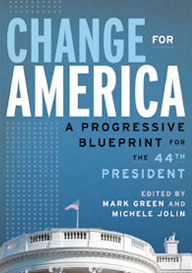

White House Office of Social Entrepreneurship?

Citing the model of City Year and the success of AmeriCorps as examples, two think tanks call for a new changeWhite House Office of Social Entrepreneurship.

The Center for American Progress Action Fund, with the New Democracy Project, will release a book in January that aims to help with President Barack Obama’s transition, “steering the government in a new, more progressive direction.”

Writing in Change For America, A Progressive Blue-Print for the 44th President, Michele Jolin explains that “The new president will take office with ambitious goals to solve our nation’s most urgent social problems, but he will be operating in a climate with limited tolerance for new government spending or government-only solutions.”

An office of social entrepreneurship in the White House — not at the Corporation for National and Community Service as has been mentioned — would establish a “policy environment that over the long term fosters new entrepreneurship, improves nonprofits’ access to growth capital, and removes outdated tax and regulatory barriers to innovation.”

Acknowledging the vital importance of the nonprofit sector — part of the private sector, and responsible for innovation and service that fall off the radar screen of government and corporations — Jolin goes onto identify specifically the social entrepreneurs of the sector who lead by example:

Within this vital and growing non-profit sector, “social entrepreneurs” — individuals who have developed system-changing solutions to solve serious social problems—are playing a unique role. Leading social entrepreneurs such as Geoffrey Canada of Harlem Children’s Zone, which provides comprehensive support to low-income children in New York’s toughest neighborhoods, and Nobel Prize–winning Muhammad Yunus of the Grameen Bank, which is the world’s most famous microlender, have developed innovative models that are reorienting the way philanthropists, the private sector, and—increasingly— policymakers address intractable problems.

Nonprofits, nimble and resourceful, can take risks and work out program models that — if successful — can be and have been successfully adpated and adopted by governments.

…the non-profit sector can be a source of innovation and experimentation, and serve as a testing ground for these new ideas. The federal government has adapted a number of successful non-profit approaches into full-scale programs. City Year’s national service successes led to AmeriCorps, for example, and a federal appropriation expanded YouthBuild into a national government program in 1993.

The cost-effective private-public partnership that is AmeriCorps has been central to the discussion of building bi-partisan support for national service.

John Podesta, Obama’s transition chief, is on leave from the Center for American Progress. To read more about the context of the recommendations, read The Chronicle of Philanthropy article.

Download the whole chapter “A New Office of Social Entrepreneurship” (PDF) from the book. See nine other chapters.

David Eisner Says Farewell

headshot_ceo_01_thumbDavid Eisner steps down as the CEO of the Corporation for National and Community Service.

(The Corporation is an independent organization established by the federal government that provides funds and accountability for AmeriCorps programs throughout the country.)

You can read his biography on the CNCS web site. And the transcript of the speech he delivered yesterday at Georgetown, “From Dropouts to Downturns — Why Service is America’s Solution.”

This letter was posted yesterday as a “thank you and farewell.”

Dear National Service Colleagues,

It feels strange to be stepping down as CEO of the Corporation at this time in the national service movement – like jumping off a train just as it is picking up speed! As I leave, I want to share just how much the work you all do has meant to me, how grateful I am to have had the privilege to represent you, and how confident I am about the future for the agency and for national service and volunteering in America.

As a result of our work together, today national service has improved more lives, grown stronger and more secure, expanded its base of bipartisan support, and built a culture of impact and accountability in a way that offers a solid foundation for continued growth. At the core of this movement are the citizens of America; individuals who are ready and willing to stand up and say “I care” when provided with the opportunity and the tools to do so. You are the leaders of this “I care” movement. As I mentioned in a speech to a group of idealistic Georgetown University students this morning, for five years I have traveled across the country with a mixture of awe and admiration at seeing how your work is saving lives, ensuring futures, defeating despair and restoring hope for Americans who have no other place to turn. Thank you for what you do and for letting me share a role in this amazing work.

Before I close, I want to share a few things about the individuals I leave behind at the Corporation for National and Community Service. The staff at the Corporation, both in headquarters in Washington, DC and across the country, are a top notch group of professionals who care more passionately about your success and the mission of national service than I could have ever believed possible before joining the Corporation myself. I am also indebted to Steve Goldsmith who chairs what may be the strongest and most effectively bipartisan board in Washington, DC, for his leadership, wisdom and support. Finally, I am grateful that Nicky Goren, my current Chief of Staff, will take over as Acting CEO with my departure. In Nicky you have an effective and experienced leader and champion for volunteering and national service.

If you would like to remain in touch with me, please feel free to contact my terrific assistant, Vickie Perry, for my personal email address. I will remain a cheerleader and champion for your work, and look forward to our paths crossing again.

Thank you,

David Eisner

GOOD Sheet on National Service

Have you seen this new series of sheets GOOD magazine has beengoodsheet_010_natlservice_em2 producing this year? They are folded up sheets of newsprint dedicated to a single topic. One I saw before the election was dedicated to close races — the kind where every vote counts.

This week’s is on service:

President Kennedy famously declared during his inauguration speech that we should ask ourselves what we can do for our country. National service takes many forms—from Americans deployed overseas to senior citizens teaching a new generation how to read. Now that the election is over, let’s continue the spirit of civic engagement. Find out what you can do for your country.

GOOD Magazine is a smart magazine (they assume you are smart, too — what a relief) that donates your magazine subscription fee to a nonprofit. Browse other GOOD Sheets.