Sinking Economy? Need More National Service

Harris WoffordDesperate economic times highlight the need for cost-effective, public-private measures to serve the needy in the United States.

Today national service champions Harris Wofford and Stephen Goldsmith outline the need for more national service, as a response to the economic downturn.

Excerpts below…

Food banks’ supplies are set to reach new lows. Yet this year we will see millions of citizens reach out in record numbers to assist those in need — offering food, special care and compassion.

As the government seeks to deal with the economic crisis and relieve the distress felt by millions of families, we should not overlook the great American tradition of service. More than 60 million citizens every year are providing service to their neighbors and their communities.

President-elect Barack Obama has vowed to make service a central cause of his presidency. In his call to service outlining plans for a large expansion of citizen service, he said he would reach out to Republicans, Democrats and independents alike, young and old, and ask all of us for our service and active citizenship. ”We need your service, right now,” he said.

Here are a few examples of what ”We the People” can do right now and in the year ahead:

  • We can help children in danger of dropping out of school by volunteering as tutors and mentors.
  • Skilled professionals (lawyers, accountants, et al.) can go door to door in distressed communities to assist families facing mortgage foreclosure.
  • Volunteers can support displaced families and children by helping them transition from homeless shelters to more permanent housing.
  • Since financial stress and unemployment can lead to substance abuse, psychological despair and homelessness, community assistance centers and shelters will need many new volunteers and basic supplies.

However any such new government resources should be viewed not as a jobs program but as assets and agents necessary to manage and train millions of volunteers. These new forces can be rapidly assigned to existing nonprofits to recruit and organize unpaid, shorter-term volunteers.

Last year 75,000 AmeriCorps members recruited more than 1.7 million local volunteers. One of the best examples of this is AmeriCorps’ relationship with Habitat for Humanity, where members don’t just build homes, but most of all recruit, train and manage the community volunteers on whom Habitat relies. AmeriCorps members serving with Habitat for Humanity helped mobilize 200,000 community volunteers to build 1,700 homes.

Show Your Corps Member Love this Holiday Season

Rejecting the traditional gift list, I wanted to highlight some things you can give or do over the holidays for the corps member in your life — whether they serve in your office, are in your family, or a good friend. Check out the Give List for more ideas.

1. Ask them/listen to what they say. This year it’s okay not to surprise the corps member in your life. They may actually need help with a chore or an expense and would appreciate that more than any surprise you can dream up.

2. Cash. Economists say it’s the best gift anyway, at least in terms of efficiency. Your corps member can spend it as they see fit. If it feels un-gift-like, offer it in a decorative envelope with a heart-warming letter inside telling them how much they or their service means to you. If your corps member is an international volunteer, deposit the check in their State-side bank account rather than send through the mail.

3. Food/gift cards for food. While a $25 gift card to the local boutique grocer may sound appealing to you, the gift goes further at a store like Trader Joe’s which has low prices. If your corps member is an international volunteer, find out what essential, shippable items they can’t get in their host country and send a well-sealed care package. You’d be surprised how valuable a box of corn flakes or mac & cheese is to them.

4. Subscriptions. The gifts that keep on giving. You can find subscription services for a wide range of things — like magazines, obviously; wine from a local vineyard; and even fair-trade coffee.

5. Socially responsible gifts, donations, or loans in their name. This year your corps member may be especially sensitive to the local impact and cost of goods and services, and to extravagance and waste.

If you want to offer them a material gift, consider buying something that positively impacts the community or region. For example, Echoing Green funds social enterprises and offers this gift guide.

You can also donate to a nonprofit project that means something to them, either their own project (check out this site, for donating to Peace Corps Volunteer projects); nonprofits set up for gift-giving like Heifer International; their local public radio station; or any organization with a mission your corps member believes in. Other nonprofits like HealthCorps offer branded gifts through CafePress.

Another option is lending for a good cause, in their name. For example, Kiva.org allows people to lend money online, in amounts as small as $25, to micro-enterprises around the world — you browse and choose the business you’d like to help start up. When you lend, you aren’t even giving — you’ll be repaid, and can pocket the money or lend again.

6. A party or potluck in their honor. If your corps member is home for the holidays, consider hosting a welcome-back gathering for them and their friends.

7. A visit from you. If your corps member is far from home, consider visiting them. If you can’t visit them over the holidays, announce your plan to visit another time as part of their gift.

8. Tickets to a special experience. The ballet, an athletic event, a concert. Not only will the experience be something they may not afford on their own, it’s also not something material they have to worry about transporting when they move on after their term ends.

9. Meaningful tech tools. A digital and/or video camera to record their year, a video camera add-on for their computer so you can stay in touch through Skype, a MacBook that has it all.

10. Something homemade. Anything from a scarf to a personalized cookbook to a scrapbook of their accomplishments. If you go this route, make the decision based on your own talents as well as their tastes. As with socially responsible gifts, homemade gifts aren’t necessarily cheaper, and they are more time-intensive. But they are keepsakes forever, and will always remind your corps member of this holiday season, when they served in a corps.
add to del.icio.us :: Add to Blinkslist :: add to furl :: Digg it :: add to ma.gnolia :: Stumble It! :: add to simpy :: seed the vine :: :: :: TailRank :: post to facebook

AmeriCorps Project Co-Founder Named CNN Hero of the Year

Thanksgiving night, Anderson Cooper will name Liz McCartney, co-founder of the St. Bernard Project in New Orleans, CNN’s Hero of the Year. The Project credits the involvement of AmeriCorps members with its success.

The following is copied directly from the press release issued by the Corporation for National and Community Service that funds and governs AmeriCorps programs:

Ms. Beatrice and a relative

Ms. Beatrice and a relative

Washington DC — Liz McCartney, cofounder of a Louisiana nonprofit that engages volunteers and AmeriCorps members to rebuild homes destroyed by Hurricane Katrina, was named the 2008 CNN Hero of the Year at a ceremony Saturday night in Hollywood.

McCartney received $100,000 to continue the project’s work in rebuilding homes in St. Bernard Parish. McCartney had already received $25,000 for being one of 10 finalists.

The “CNN Heroes: An All-Star Tribute” ceremony, hosted by AC 360 host Anderson Cooper and featuring musical performances by Christina Aguilera, Alicia Keys, and John Legend, will be broadcast on CNN at 9 p.m. EST on Thanksgiving.

“To the country and the world, I ask you to please join us,” said McCartney in her acceptance speech. “Together we can continue to rebuild families’ homes and lives. If you join us, we’ll be unstoppable.”

The top ten finalists were selected from more than 3,700 nominations by a panel that included Magic Johnson, Kristi Yamaguchi, Deepak Chopra, and Desmond Tutu. McCartney was chosen as CNN Hero of the Year after six weeks of online voting in which more than 1 million votes were cast.

Liz McCartney, CNN Hero of the Year 2008

Liz McCartney, CNN Hero of the Year 2008

McCartney formed the St. Bernard Project two years ago with her boyfriend Zack Rosenburg after the couple came to the New Orleans area to volunteer in the wake of Katrina.  Shocked by the widespread destruction, they quit their professional jobs in Washington D.C. and moved to Louisiana.

The project has mobilized more than 9,000 volunteers to renovate and reconstruct 151 homes for residents of St. Bernard Parish.  It has relied heavily on the intensive service of AmeriCorps members to do construction work and manage volunteers. In the past two years, 260 AmeriCorps members have provided more than 80,000 hours of service, trained and managed more than 8,000 volunteers; supervised and worked side-by-side with volunteers to rebuild 120 families’ homes; provided more than $1 million worth of in kind volunteer supervision and labor; and helped raise more than $2 million in funds.

“We would not be where we are today without our partnership with AmeriCorps. This award is a tribute to all of our efforts,” McCartney said yesterday.  “Our relationship with AmeriCorps has been a very powerful and effective force for the community.”

The project works with families to do reconstruction work that’s needed to allow them to move back in. This varies from house to house but typically includes mold remediation, rewiring, plumbing, insulation, sheetrock, cabinetry, installing appliances and cabinets, and other tasks. It takes an average of 12 weeks and $12,000 to rebuild a home.

“I am surrounded by the people who are the real heroes, the people of St. Bernard who have put up with so many challenges and are still fighting for their community. The problems are big but the solutions are readily available. This award is great for the community because it will put St. Bernard and the New Orleans area in the national spotlight and show that we are making progress but still need volunteers,” McCartney said.

At the CNN Heroes ceremony, the top 10 finalists were introduced by celebrity presenters including actors Cameron Diaz, Salma Hayek, John Krasinski, Forest Whitaker, Meg Ryan, Terrence Howard, Lucy Liu, Jessica Biel, Kate Beckinsale and Selena Gomez.  The CNN Heroes campaign salutes everyday people accomplishing extraordinary things in their communities and beyond.  For more information about CNN Heroes, visit http://www.cnn.com/SPECIALS/2008/cnn.heroes/

The Corporation for National and Community Service is a federal agency that improves lives, strengthens communities, and fosters civic engagement through service and volunteering. Each year, the Corporation engages four million Americans of all ages and backgrounds in service through its Senior Corps, AmeriCorps, and Learn and Serve America programs. For more information, visit  www.NationalService.gov.

See the original The New Service post about Liz McCartney as a Top Ten Hero from Oct. 24.

How the Media get National Service Wrong (Sometimes)

As news media pick up stories about graduating students missing out on high-power corporate jobs and falling back on national service, some details are skewed.

Here is my rebuttal to some stories I’ve seen in the media lately about national service as a solution to college student angst about employment and loan repayment. Like this one from the Wall Street Journal, and this one from MSN Money.

A term of national service is not the same as nonprofit employment. And there’s a lot more to public service than a year of stipended national service. It’s misleading to say that when the Class of 2009 is locked out of entry level positions at huge corporations, they may opt for “nonprofit work” by joining AmeriCorps for $10,000 a year.

What’s wrong with that kind of reporting?

1. Recent coverage is perpetuating the false idea that only people rejected from business careers look into national service and nonprofit work.

Service is not the job you can get when no one else will hire you. Competition is high for national service slots. Far more people apply to most service corps than there are openings. For example, Teach For America saw 25,000 applications last year, but only needed a fraction of that to fill all its corps member openings. Chicago’s Inner City Teaching Corps has gotten five times the number of applicants than it’s had openings.

Service organizations are looking for people committed to social justice, who actually have volunteer, leadership, and issue-focused experience. People for whom a term of service is a plausible commitment, and who have something to offer communities.

And in fact, you can actually graduate from college aspiring to a national service experience or nonprofit career — because you are committed to social change, community issues, living your faith, etc. That is, if people who are mentoring you can educate you about these kinds of opportunities.

Mid-career professionals who’ve dedicated their lives to earning their companies a profit are often surprised to find how tricky it is to break into the nonprofit sector. While business skills are valuable in running nonprofit organizations, and many nonprofit careerists earn MBAs, the nonprofit sector is not the repository of people who didn’t make it as capitalists.

Not that there’s anything wrong with being a capitalist.

2. A term of national service is not an alternate career path or a nonprofit job.

A term of service is usually a year or two — it’s not exactly an alternative career path. It’s short term. After your term you can decide what to do next — you’ll have more experience than you did as a college senior, but your options in life are still as wide open.

While most U.S.-based service programs are 501(c)(3) nonprofits themselves, corps members are supported by a range of host sites, not just nonprofits. Corps members teach in public schools and serve in local government agencies, as well as in nonprofit organizations.

Nonprofit careers do exist — and national service is a great launching point. To understand nonprofit careers better, check out the Idealist.org Guide to Nonprofit Careers.

3. Finally, one of the biggest misunderstandings people—including reporters—have is that nonprofit = no money. That nonprofit work is volunteer work and doesn’t count as a “real job” that can support a person or family.

At Idealist.org we have had to work hard, and will continue to work hard, to get people — college students, career counselors, parents, mid-career professionals — to let go of certain notions they have of nonprofit employment.

Saying that college grads will settle for a $10,000/year “job” in the nonprofit sector because of the loan repayment benefit implies that nonprofits pay poverty wages to staff. That’s a serious issue for the nonprofit sector wanting to beef up its workforce and leadership pipeline (PDF) in time for baby boomers to retire. And it’s irresponsible journalism.

From the Idealist.org document debunking the top-ten myths about the nonprofit sector:

The term “nonprofit” refers to the 501(c) tax code in the United States. Non-governmental organization, or NGO, and “charity” are the common terms used outside the United States. Revenues generated by nonprofit organizations go back into programs that serve the organizations’ mission. There are no stockholders receiving annual financial dividends, and employees do not receive a bonus at the end of a good year. According to Independent Sector, $670 billion are earned by nonprofit organizations annually, and one in twelve Americans work in the nonprofit sector.

To learn more about the nonprofit sector, read Chapter One of the Idealist.org Guide to Nonprofit Careers. To learn more about nonprofit salaries, check out these free, online resources: Occupational Outlook Handbook, Salary.com, and CareerBuilder.com (use the term “non-profit,” with a hyphen).

To learn more about service opportunities, check out the Corps and Coalitions list on the right-hand sidebar of this blog.

David Eisner’s recent speech about the need for national service explains its value from the perspective of governing healthy communities during an economic downturn.

White House Office of Social Entrepreneurship?

Citing the model of City Year and the success of AmeriCorps as examples, two think tanks call for a new changeWhite House Office of Social Entrepreneurship.

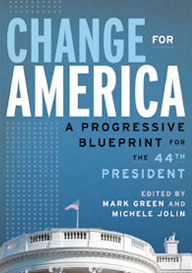
The Center for American Progress Action Fund, with the New Democracy Project, will release a book in January that aims to help with President Barack Obama’s transition, “steering the government in a new, more progressive direction.”

Writing in Change For America, A Progressive Blue-Print for the 44th President, Michele Jolin explains that “The new president will take office with ambitious goals to solve our nation’s most urgent social problems, but he will be operating in a climate with limited tolerance for new government spending or government-only solutions.”

An office of social entrepreneurship in the White House — not at the Corporation for National and Community Service as has been mentioned — would establish a “policy environment that over the long term fosters new entrepreneurship, improves nonprofits’ access to growth capital, and removes outdated tax and regulatory barriers to innovation.”

Acknowledging the vital importance of the nonprofit sector — part of the private sector, and responsible for innovation and service that fall off the radar screen of government and corporations — Jolin goes onto identify specifically the social entrepreneurs of the sector who lead by example:

Within this vital and growing non-profit sector, “social entrepreneurs” — individuals who have developed system-changing solutions to solve serious social problems—are playing a unique role. Leading social entrepreneurs such as Geoffrey Canada of Harlem Children’s Zone, which provides comprehensive support to low-income children in New York’s toughest neighborhoods, and Nobel Prize–winning Muhammad Yunus of the Grameen Bank, which is the world’s most famous microlender, have developed innovative models that are reorienting the way philanthropists, the private sector, and—increasingly— policymakers address intractable problems.

Nonprofits, nimble and resourceful, can take risks and work out program models that — if successful — can be and have been successfully adpated and adopted by governments.

…the non-profit sector can be a source of innovation and experimentation, and serve as a testing ground for these new ideas. The federal government has adapted a number of successful non-profit approaches into full-scale programs. City Year’s national service successes led to AmeriCorps, for example, and a federal appropriation expanded YouthBuild into a national government program in 1993.

The cost-effective private-public partnership that is AmeriCorps has been central to the discussion of building bi-partisan support for national service.

John Podesta, Obama’s transition chief, is on leave from the Center for American Progress. To read more about the context of the recommendations, read The Chronicle of Philanthropy article.

Download the whole chapter “A New Office of Social Entrepreneurship” (PDF) from the book. See nine other chapters.