Volunteers teach college-level English in China’s interior for two years, including a summer of intense  training. Livable monthly stipend, top-notch health benefits, Mandarin language education, network of other volunteers throughout the Southwest.
Peace Corps’s China program is one of my alma maters, and is a recruitment priority right now for Peace Corps. So I am sneaking it in as part of this week’s focus on teaching corps. Read about Peace Corps’s education programs more broadly.
Next week (Nov. 8th) my friend and China RPCV Kate Kuykendall, a public affairs specialist for the L.A. recruitment office, will host an Online Info Session about Peace Corps China that you can tune into for even more information.
A word about teaching English
The notion of teaching English doesn’t seem as glam as other overseas volunteer assignments like business or public health.

Chinese lecture hall, by Alison
But English is a skill that people from the United States tend to have, and that other countries want for their youth. If you are looking to contribute to the development of other countries and build the capacity of young people there, English is a skill you can export and feel good about.
The other thing about teaching English is that right from the start of your term, before you can speak well in their language, your students can serve as insightful cultural informants to help you navigate your new life. Read about teaching English in China with Peace Corps.
Pre-service training
Trainees in the China program live in homestays during the two months of pre-service training, learn how to effectively teach English to large groups of students, study Chinese language in small groups with exceptional teachers, learn how to stay healthy (i.e., don’t drink unboiled water, what to do in case of unmentionable stomach ailments, etc.), receive scheduled immunization shots, and at the end of the summer, are sworn in as Peace Corps Volunteers.
Placement
Volunteers serve in teachers colleges in the interior of China, and teach classes of 40-60 students at a time.

English library, photo by Alison
Subjects include English literacy, conversation, and British and U.S. literature and culture. The work week includes several courses, office hours, and often a teacher-hazing ritual called “English Corner.” Students typically come from very poor, rural areas, with plans to return home to teach English at the middle-school level. Colleges in China are more likely to be in cities, so China placements tend to be urban, where Volunteers live rent-free in modestly furnished campus apartments. Read some basics about living in China.
Benefits

A large Chinese kitchen, photo by Alison
Benefits of Peace Corps service — other than that your understanding of the world is enriched forever — include airfare to and from your country of service, health care (including prescription and over the counter medicines, yearly exams, evacuation home if the medical attention you need is not available in-country), a monthly stipend that is on par with that of locals, two vacation days per month (plus local holidays and weekends), reimbursement and per diem for all service-related travel, and just over $6,000 disbursed to you when your term of service ends.
If natural disaster, political unrest, plague, etc. make your stay in China untenable, Peace Corps will evacuate you and your group. Read more about the recent closing of the Bolivia program. In 2003, the Peace Corps China program was completely emptied out in response to the SARS epidemic.
In addition to pre-service language training, Peace Corps reimburses you the expense of on-going private language instruction once you are at your service placement. A few times a year you have the opportunity to head to trainings at Peace Corps country headquarters (in China, this is located in Chengdu, Sichuan, very near the May earthquake epicenter).
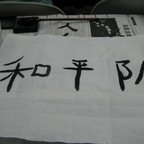
heping dui, photo by Alison
Educational benefits include deferring qualified student loans during your term of service (and partial cancellation of Perkins loans). Once you are back, you are eligible to apply for special fellowships at grad schools through the Fellows USA program, especially designed for Returned Peace Corps Volunteers (RPCVs). (For people who have not yet joined Peace Corps, also consider Peace Corps Masters International, which allows you to do Peace Corps service as part of a master’s degree). Read more and listen to a podcast on Peace Corps and grad school.
Peace Corps China journalists
No discussion of Peace Corps’s China program would be complete without mentioning the journalists who have graduated from it. While most China RPCVs have gone on to do great things in many fields, the group has produced several noteworthy writers and journalists.

Pete and a Chinese man, photo by Mark Leong
These men’s voices weigh in on our understanding of China. They are helping people in the U.S. create a new consciousness of China, about the complexities of its culture, its conflicting priorities as it develops. The value of their contribution lies in their knowledge of the language, people, and context of China with a depth the U.S. reader hasn’t seen since missionary-era writers like Pearl Buck.
The emphasis Peace Corps China has traditionally placed on friendship (the Chinese name for the group is the Sino-U.S. Friendship Volunteers), cross-cultural and cross-linguistic understanding, produces a wider lens through which to view the nation and its billion-plus people — a lens some other journalists in China simply haven’t had.
It’s not that these journalists are apologists for the unsavory things the Chinese government does. But we aren’t going to learn anything about China, or any country, if we look only at the actions of a government and never at the people themselves… If we only listen to press conferences and never to the voices of the farmer or factory worker.
Multimedia
The independent Peace Corps Wiki is an alternative source of information about Peace Corps. Here’s the China wiki.
Read the online journal entries of Michelle Ross who served in China from 2006-08, and listings of other Peace Corps China blogs.
Check out this Google presentation featuring China RPCV Pete Hessler speaking about his writing and experiences in Peace Corps.
Check out the official Peace Corps Video Vault, where Volunteers speak to some of the most frequently-asked questions Peace Corps applicants have.
Resources
And a repeat: Next week (11/8) my friend and China RPCV Kate Kuykendall, a public affairs specialist for the L.A. recruitment office, will host an Online Info Session about Peace Corps China that you can tune into for even more information.
For more resources on graduate education, check out the Idealist.org Public Service Graduate Education Resource Center, and if you live in the vicinity of Georgia, come to our final graduate admissions fair coming to Atlanta on Monday, 11/3.
This week The New Service blog is looking at education service corps. While many service corps programs have application due dates in the spring for a fall start date, most education service corps have deadlines throughout the winter and start in the summer. Check out this list of education-related opprotunities that don’t require an education degree.
 The Peace Corps China community grieves the loss one of the program’s ground breakers, its longest-serving staff member, and a paragon of diplomacy, intercultural communication, and humanity.
 Dr. Speidel cited an example of when the staff experienced problems importing medical supplies for the new program. Ms. Zhan spent a long time negotiating with Chinese officials to make the arrangements possible. During my time in Peace Corps in the late 90’s, I witnessed countless such negotiations. Ms. Zhan could handle any conflict, it seemed, with staggering grace and effectiveness. She was one of the strongest and most even-keeled people I know. She fought doggedly for us, and we truly loved her.
 ::
::  ::
::  ::
::  ::
::  ::
::  ::
::  ::
::  ::
::  ::
::  ::
::  ::
:: 


 The New Service