Google’s “Project 10 to the 100th” Contest

To celebrate its 10th birthday, Google has launched a new Project 10100 contest. The text below has been copied from the project’s web site. Read the Spanish here.

May Those Who Help The Most Win

Why this project?

Never in history have so many people had so much information, so many tools at their disposal, so many ways of making good ideas come to life. Yet at the same time, so many people, of all walks of life, could use so much help, in both little ways and big.

In the midst of this, new studies are reinforcing the simple wisdom that beyond a certain very basic level of material wealth, the only thing that increases individual happiness over time is helping other people.

In other words, helping helps everybody, helper and helped alike.

The question is: what would help? And help most?

At Google, we don’t believe we have the answers, but we do believe the answers are out there. Maybe in a lab, or a company, or a university — but maybe not.

Maybe the answer that helps somebody is in your head, in something you’ve observed, some notion that you’ve been fiddling with, some small connection you’ve noticed, some old thing you have seen with new eyes.

If you have an idea that you believe would help somebody, we want to hear about it. We’re looking for ideas that help as many people as possible, in any way, and we’re committing the funding to launch them. You can submit your ideas and help vote on ideas from others. Final idea selections will be made by an advisory board.

Good luck, and may those who help the most win.

Category Descriptions

Here are the categories in which we’ll be considering ideas.

  • Community: How can we help connect people, build communities and protect unique cultures?
  • Opportunity: How can we help people better provide for themselves and their families?
  • Energy: How can we help move the world toward safe, clean, inexpensive energy?
  • Environment: How can we help promote a cleaner and more sustainable global ecosystem?
  • Health: How can we help individuals lead longer, healthier lives?
  • Education: How can we help more people get more access to better education?
  • Shelter: How can we help ensure that everyone has a safe place to live?
  • Everything else: Sometimes the best ideas don’t fit into any category at all.

How it works

Project 10100 (pronounced “Project 10 to the 100th”) is a call for ideas to change the world by helping as many people as possible. Here’s how to join in.

1. Send us your idea by October 20th.
Simply fill out the submission form giving us the gist of your idea. You can supplement your proposal with a 30-second video.

2. Voting on ideas begins on January 27th.
We’ll post a selection of one hundred ideas and ask you, the public, to choose twenty semi-finalists. Then an advisory board will select up to five final ideas. Send me a reminder to vote.

3. We’ll help bring these ideas to life.
We’re committing $10 million to implement these projects, and our goal is to help as many people as possible. So remember, money may provide a jumpstart, but the idea is the thing.

Good luck, and may those who help the most win.

Submit your idea here! Deadline: Oct. 20!

Support for LGBT Peace Corps Volunteers and applicants

Group of Returned Peace Corps Volunteers offers support to LGBT applicants, and help for Peace Corps recruiters, too.

Living two years in a developing country is rough — homesickness, language, culture, infrastructure, lack of creature comforts, etc. For people who are gay or lesbian, the experience can be even more challenging in cultures where same-sex relationships are hidden due to intolerance or fear of punishment.

So for gay, lesbian, bisexual and transgender Peace Corps applicants, a lot of questions can arise that have tough answers. Questions like “Will I have to be celibate for two years?” or “How am I going to get myself back in the closet after working so hard to get out of it!?” And the mother of them all, “Can my partner and I serve together?”

In 1991 Mike Learned founded LGB RPCVs, one of many chapter groups affiliated with the National Peace Corps Association (NPCA) — the support and advocacy organization for Returned Peace Corps Volunteers (RPCVs).

Most NPCA chapter groups are based on the U.S. region where RPCVs live now — for example Boston Area Returned Peace Corps Volunteers— or else they are based on the country of service — for example Friends and RPCVs of Guyana.

LGB RPCVs is unique in that it unites returned Volunteers who served across the world, and who also now live across the globe. Its web site presents articles and Frequently Asked Questions for people considering Peace Corps service. The group also issues regular newsletters and features resources for Peace Corps staff to better understand policies that pertain to future Volunteers who are LGBT.

The Mentor Program — the groups’ “most successful outreach and recruitment project” — connects these future Volunteers with LGBT returned Volunteers in order to discuss life in Peace Corps.

Several years ago my friend Kate Kuykendall, then a Peace Corps recruiter, was interviewed for the LGB RPCV web site. In that interview she answers some of the questions posed above, and elaborates on the challenges of talking about the Peace Corps experience and sexual orientation with LGBT applicants.

Kate now works as a Peace Corps public affairs specialist for Peace Corps in Los Angeles and is a lesbian and a newlywed. I asked her if new state laws legalizing gay marriage affect the ability of gay couples to serve together in Peace Corps.

She said, “The recent changes to certain state marriage laws do not affect the Peace Corps’ policy of not placing [LGBT] couples together.  This is because, as a federal agency, the Peace Corps must abide by the federal definition of marriage, which is limited to the marriage between a man and woman.  The Defense of Marriage Act, passed in 1996, is the law that prohibits any other interpretation of marriage.”

And for now at least unmarried couples cannot serve together in Peace Corps. Even siblings and other family members are turned down if they want a guarantee they’ll be posted to the same country, assignment, site, etc.

To find other groups of RPCVs, see the list on the National Peace Corps Association web site.

Dr. Oz’s Day of Zumba Action

Dr. Oz on Oprah

Dr. Oz on The Oprah Winfrey Show

Yeah, I know, this isn’t a competition.

But I challenge anyone to come up with a more imaginative, more entertaining way to highlight the national service movement and health issues than a zumba Latin dance-off for diabetes.

That’s how Dr. Mehmet Oz—heart surgeon, author, frequent Oprah guest, and HealthCorps founder—is participating in the Day of Action, Sept. 27. In doing so, he will join over 2,500 other community service projects taking place all over the United States as part of Service Nation, the campaign for more citizen service and community activism.

Dr. Oz will lead a zumba Latin dance demonstration of his own with over 200 participants as part of the American Diabetes Association‘s Diabetes Expo at the Javits Center in Manhattan. The effort aims to highlight the impact of national service and HealthCorps’s commitment to fighting diabetes and childhood obesity.

Dr. Oz says, “We can’t remedy our country’s health crisis by legislating solutions. I created HealthCorps to send volunteers to our nation’s high schools to mentor their adopted brothers and sisters. They’re making health cool and hip. Besides eating smart and exercising wisely, they’re teaching mental resilience and addressing underserved communities.”

HealthCorps is a school-based peer mentoring and community outreach program that deploys recent college graduates to empower teens to become educated consumers and health activists.

HealthCorps seeks to expand its 45-school program to serve more states, develop even more of an emphasis on consumer education, and encourage all Americans to prioritize prevention and personal responsibility.

HealthCorps members typically go on to attend medical school or engage in other public health careers.

Dr. Oz fans will be glad to hear that in September 2009 he’s set to host “The Dr. Oz Show,” a syndicated talk show produced by Oprah’s Harpo Productions.

In a week, communities all over the United States will answer the call to serve on Service Nation’s Day of Action, Sept. 27th. Idealist.org staff are organizing our first-ever Youth Action Fair in New York.

Find a project to participate in, in your community.

But…what is zumba? This is the shortest (and cutest) demo I could find on Youtube:

Watch Dr. Oz speak (not dance) during the Day of Action event:

Here is the Zumba class that took place that day:

City Year Gears Up for Opening Day

Friday, Sept. 26, Ciy Year groups throughout the country will swear-in new corps members during Opening Day ceremonies. The new corps members will take both the City Year pledge (see below) and the AmeriCorps pledge. The ceremony is the culmination of a month of intense pre-service training, as well as the launch of ten months of full-time service.

In some cities Corps members will follow Opening Day with service projects, such as preparing care packages for hospitalized children as part of Worldfest in Little Rock, AR, or working on the grounds of a public elementary school in Louisiana.

City Year was founded 20 years ago, graduating more than 10,000 participants. City Year corps members serve in one of 17 U.S. cities and in Johannesburg, South Africa in schools and neighborhoods as tutors and leaders for a year of full-time service. Read more about City Year’s projects and initiatives.

Here is the City Year pledge:

I pledge to serve as a City Year corps member
to the very best of my ability,
to honor the rules and expectations of City Year,
to respect my colleagues and the people and
communities we serve,
to provide excellent service,
to lead by example and be a role model to children,
to celebrate the diversity of people, ideas and
cultures
around me,
to serve with an open heart and an open mind,
to be quick to help and slow to judge,
to do my best to make a difference in the lives of
others
, and
to build a stronger community, nation and world,
for all of us.

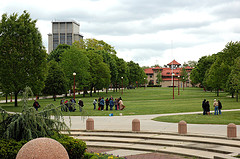
The Grad School Campus Visit

Top things to know when you are shopping for schools

I don’t travel to as many of our Idealist.org graduate admissions fairs as I used to, but when I do I love to hear from admissions staff who table at the events about their day-to-day activities back at school. Over time I have had quite a few conversations about the Campus Visit and wanted to share some nuggets of wisdom here.

Visiting the admissions office:

One recent discussion was with Emmett Griffin of Georgetown Public Policy Institute about prospective students’s visits to his office. These are his tips:

As with any professional encounter, it’s wise to make an appointment with an admissions officer, a week ahead of time if possible. Admissions staff are busy. You’ll make a much better first impression if you set up a time to meet, and they are expecting you.

Read before you go. Of course you want to ask a lot of questions. But before asking anything of a school’s faculty or staff, read the web site and/or any available print material. Those will likely answer a lot of your questions, and you’ll make a better first impression if you have done your homework (this is, er, school, after all). (Imagine if you had a job where you were constantly asked questions — wouldn’t you answer all the most common questions on your web site and in your brochures?)

What if you happen to be visiting a city for other reasons and decide to drop by campus for an unannounced visit? Still call ahead, even if it’s just an hour ahead — and read as much as you can, even if it’s skimming all you can get your hands on in the admissions office itself, before chatting with an admissions officer.

Visiting classes:

The tips below are from conversations with Idealist’s Graduate Admissions Advisory Board (of which Emmett Griffin is a member):

Consider visiting a class or two while you are on campus.  But do not show up to a class unannounced. Schools love for prospective students to sit in on a class or two and will have different policies about how to set up the class visit.

Contact your target school’s admissions office, or the department. Sometimes you can sign up for a class visit right on the web site, other times the admissions office will direct you to the registrar or individual professor.

Also, professors might want you to have read some course materials ahead of time and expect you to participate in class discussions. Find out about these expectations ahead of time, if possible.

Other activities while you are on campus:

• Talk with someone in the career center about internship and career transitions support (grad schools often have their own career office)
• Meet with a current student to ask what it’s like to be a student there (see this article about informational interviews)
• Participate in a campus tour; many schools offer these a few times per day. The admissions office can let you know the details

Before you go, write a list of questions and/or considerations you’d like to keep in mind on the day of your visit. It might also be a good idea to jot down your top priorities in a school so you can objectively evaluate your experience later on. For example, if you intend to use the athletic facilities, you’d want to make sure you get to see them and find out how much (if anything) it costs to use them. You might be looking for an academically rigorous environment, or a lot of support setting up excellent internships.

Reflection:

When you get home, reflect on your list of questions:

√ What did I learn?
√ How interested am I in exploring this academic program further?
√ What values, skills, and interests of mine fit – or don’t fit – with the degree, department, or student culture?
√ What are my next steps from here?

Thanks:

After you visit, send thank-you notes to the professors, students and staff you met with. You can have the thank-you notes stamped, addressed and ready to go (save for writing the note itself) when you arrive on campus. As your last stop on campus, take a few minutes over coffee or lunch to write the notes, and pop them in the nearest mail box. The important thing is to make  the note meaningful, and to state something specific you learned. If possible, enclose your business card in the envelope.

Read more about grad school choices, admissions, and financial aid.

Find an Idealist.org Graduate Degree Fair for the Public Good in a city near you. (We are only going to 18 cities this year — we are genuinely sorry if we miss yours.) We’re coming to Philadelphia Monday 9/22, then off to the West Coast!

Blog for us (deadline extended).