Teach For India, Teach For All – Wendy Kopp’s Vision Gone Global

Modeled after the success of Teach For America, Teach For India aims to stamp out inequities in India’s schools by recruiting top college grads to teach in its poorest schools for two years.

Initiated in 2007, about 100 TFI Fellows will serve starting next fall in Mumbai and Pune and conduct classes in English. TFI Fellows will earn a competitive starting teachers salary, and receive compensation for housing banner_apply and transportation.

Struggling students will have access to some of the country’s brightest young leaders. While TFI Fellows will be trained and challenged. They will carry with them the experiences in the classroom far into their careers, whatever path they take.

As in the United States, India’s educational system has some stark statistics:

  • According to India’s 2001 Census, only 61% of the country’s population is literate. For women, the literacy rate is even lower than the national average, at 48%.
  • There are currently 7,500,000 children out of school in India.
  • Out of every 100 children in India, 15 will never attend school. Of those who attend school, 50% will drop out before Class V.

Reading through the web site of Teach For India (TFI) reminds me of reading the Teach For America (TFA) web site — similar vision, similar model, similar theory of change. To solve the problems of under-qualified teachers and outdated teaching methodology, India looked to Teach For America as a successful model. But India wasn’t the only country asking TFA for advice; apparently many other countries were. From the TFI web site:

In 2007, a new organization called Teach For All was created to support entrepreneurs in other countries who were pursuing the development of the Teach For America model locally. Teach For All was launched at the Clinton Global Initiative in September of 2007. Although a significant resource for Teach For India, Teach For All is a separately incorporated, funded, and staffed organization that is being incubated within Teach For America.

A “global network of independent social enterprises,” Teach For All-affiliated programs are operating or developing in ten nations, including the Latvia, Australia, Germany, and the United Kingdom.

map_4Note that like TFA, these other programs seem to be recruiting their own best and brightest (i.e. they are not overseas service opportunities for U.S. citizens—see Peace Corps, Jesuit Volunteers International, VSO Canada, and Atlas Service Corps —just a sampling of opportunities if you are from the United States and are eager to serve abroad).

Obamas, Public Allies in the Spotlight

Service program receives more, positive, media attention while solving tough social problems for communities and offering professional growth for corps members.

logo

Public Allies has received a lot of tough press among obscure blogs this year, but with established connections to the future President and First-Lady, the outlook in the media has just gotten brighter for the national, Milwaukee-based AmeriCorps program.

Here are just a couple news items involving Public Allies in the past week since the election:

The National Public Radio show Morning Edition mentioned Public Allies this morning in a discussion of Michelle Obama’s executive experience since graduating from law school. She was the founding Executive Director of Public Allies Chicago.

The San Francisco Chronicle published this article about social entrepreneurs’s hopes for the new administration. The New York Post ran an article on Michelle Obama.

Michelle Obama chatted last week with a Newsweek journalist about her experience with Public Allies and the future of national service generally:

[Richard Wolffe:] You want to continue what you did with Public Allies (which trains young people to become leaders of community groups and nonprofits) as First Lady. What’s your thinking on how to go about that?

images[Michelle Obama:] Barack is talking about a deeper investment in national service; that’s been part of his platform. He’s been meeting with some of the leadership of the AmeriCorps national-service movements—the Public Allies, the Teach for Americas, the City Years of the World—and figuring out how do we use that model, expand upon it, and help use that as a more creative way to defray the costs of college for young people and get all Americans really engaged. What AmeriCorps showed me, during the time that I worked on it, is that all these resources of young people, and not-so-young people, as I call them—because AmeriCorps is not just for young adults but people of all ages—you can fill a lot of gaps with the help of community-service hours. The young people in my program worked as program directors. They worked with kids and they worked in parks and they worked with nonprofit organizations that didn’t have the resources to bring people in full time. So this is one of those clear win-wins. You can help kids pay for school, you can get needed man-hours into really critical things like the environment, senior care, Head Start—a whole range of things. And you get the country more focused on giving back.

Earlier this year, Fast Company named Public Allies and its President and CEO Paul Schmitz one of the top 45 Social Entrepreneurs Who Are Changing the World.

11/12/08 an article about Public Allies appeared in the Pittsburgh Post-Gazette.

11/13/08 in Canada’s National Post.

What is Public Allies?

Public Allies is a 10-month service and leadership program that serves in 15 cities across the United States.  Corps members — called “Allies” — serve with nonprofits and universities to “create, improve and expand services that address diverse issues, including youth development, education, public health, economic development and the environment.”

The monthly stipend (at $1300-$1800) is higher than many AmeriCorps programs, and Allies are eligible for the $4725 AmeriCorps education award at the end of the term. But the best benefit of the program may be its extraordinary training opportunities. This, from the Public Allies web site:

A rigorous leadership development curriculum delivered by community leaders, practitioners and educators, which includes:

  • Intensive weekly skill training and leadership development seminars
  • Critical feedback, reflection, and personal coaching toward individual performance and professional goals
  • Community building and team projects with a diverse cohort of peers
  • Presentations of learning at the end of the year to demonstrate how one met the learning outcomes of the program

Good news for Public Allies and for national service

Not only Public Allies stands to benefit from the media attention, but national service as a whole does as well, including efforts like Service Nation, the campaign for expanded funding for service.

Besides the media attention, no president has had as much direct experience with the challenges and opportunities of national service as President-Elect Obama, who was a founding board member of Public Allies Chicago. He stepped down from his board post before Michelle Obama joined as staff.

Read more

Read more about applying to Public Allies, its distinguished alumni network, hiring a graduating Ally for your organization, hosting an Ally at your organization, and the program’s legacy of achievement.

On Michelle Obama and Public Allies, check out the Public Allies factsheet, and look for this year’s Michelle: A Biography by Liza Mundy at your local library.

Pres. Obama and Government Careers

images-4With record numbers of first-time voters and young people backing Obama’s presidency, perhaps a new generation of government workers will not be so hard to recruit after all.

With Baby Boomers retiring in droves over the next decade, fears have been widespread in public and nonprofit sectors that the United States will face a leadership shortage.

Not enough young people have shown an interest in government careers, and in-roads to government careers are not well known. Government has a reputation of being inefficient, less lucrative than business sector work, and very, very bureaucratic. People cite student loans that are just too high, and the need for better marketing of the compelling opportunities available in the government.

“This will not be a call issued in one speech or one program – this will be a central cause of my presidency. We will ask Americans to serve. We will create new opportunities for Americans to serve. And we will direct that service to our most pressing national challenges.”– U.S. President-Elect Barack Obama during a speech given at the University of Colorado, Colorado Springs July 2, 2008.

John F. Kennedy inspired a generation of youth to serve through initiatives like Peace Corps. Will a new generation of people — young people and people who are recently discovering civic engagement — be inspired to join the ranks of an Obama-led federal government? What do you think?

If you are considering a career in government — whether you supported McCain or Obama during this election cycle — you should know about these resources:

President-Elect Obama has been particularly clear that his administration will count on the help of people who have supported his candidacy and on those who didn’t. Young people may accept this invitation by entering the government workforce. If they do so with the enthusiasm and turn-out they have shown in his election bid, the looming leadership crisis may fail to materialize.

Peace Corps China – Teaching future teachers

Volunteers teach college-level English in China’s interior for two years, including a summer of intense training. Livable monthly stipend, top-notch health benefits, Mandarin language education, network of other volunteers throughout the Southwest.

Peace Corps’s China program is one of my alma maters, and is a recruitment priority right now for Peace Corps. So I am sneaking it in as part of this week’s focus on teaching corps. Read about Peace Corps’s education programs more broadly.

Next week (Nov. 8th) my friend and China RPCV Kate Kuykendall, a public affairs specialist for the L.A. recruitment office, will host an Online Info Session about Peace Corps China that you can tune into for even more information.

A word about teaching English

The notion of teaching English doesn’t seem as glam as other overseas volunteer assignments like business or public health.

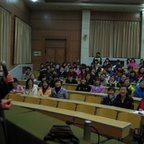
Chinese lecture hall, by Alison

Chinese lecture hall, by Alison

But English is a skill that people from the United States tend to have, and that other countries want for their youth. If you are looking to contribute to the development of other countries and build the capacity of young people there, English is a skill you can export and feel good about.

The other thing about teaching English is that right from the start of your term, before you can speak well in their language, your students can serve as insightful cultural informants to help you navigate your new life. Read about teaching English in China with Peace Corps.

Pre-service training

Trainees in the China program live in homestays during the two months of pre-service training, learn how to effectively teach English to large groups of students, study Chinese language in small groups with exceptional teachers, learn how to stay healthy (i.e., don’t drink unboiled water, what to do in case of unmentionable stomach ailments, etc.), receive scheduled immunization shots, and at the end of the summer, are sworn in as Peace Corps Volunteers.

Placement

Volunteers serve in teachers colleges in the interior of China, and teach classes of 40-60 students at a time.

English library, photo by Alison

English library, photo by Alison

Subjects  include English literacy, conversation, and  British and U.S. literature and culture.  The work week includes several courses, office hours, and often a teacher-hazing ritual called “English Corner.” Students typically come from very poor, rural areas, with plans to return home to teach English at the middle-school level. Colleges in China are more likely to be in cities, so China placements tend to be urban, where Volunteers live rent-free in modestly furnished campus apartments. Read some basics about living in China.

Benefits

A large Chinese kitchen, photo by Alison

A large Chinese kitchen, photo by Alison

Benefits of Peace Corps service — other than that your understanding of the world is enriched forever — include airfare to and from your country of service, health care (including prescription and over the counter medicines, yearly exams, evacuation home if the medical attention you need is not available in-country), a monthly stipend that is on par with that of locals, two vacation days per month (plus local holidays and weekends), reimbursement and per diem for all service-related travel, and just over $6,000 disbursed to you when your term of service ends.

If natural disaster, political unrest, plague, etc. make your stay in China untenable, Peace Corps will evacuate you and your group. Read more about the recent closing of the Bolivia program. In 2003, the Peace Corps China program was completely emptied out in response to the SARS epidemic.

In addition to pre-service language training, Peace Corps reimburses you the expense of on-going private language instruction once you are at your service placement. A few times a year you have the opportunity to head to trainings at Peace Corps country headquarters (in China, this is located in Chengdu, Sichuan, very near the May earthquake epicenter).

heping dui, photo by Alison

heping dui, photo by Alison

Educational benefits include deferring qualified student loans during your term of service (and partial cancellation of Perkins loans). Once you are back, you are eligible to apply for special fellowships at grad schools through the Fellows USA program, especially designed for Returned Peace Corps Volunteers (RPCVs). (For people who have not yet joined Peace Corps, also consider Peace Corps Masters International, which allows you to do Peace Corps service as part of a master’s degree). Read more and listen to a podcast on Peace Corps and grad school.

Peace Corps China journalists

No discussion of Peace Corps’s China program would be complete without mentioning the journalists who have graduated from it. While most China RPCVs have gone on to do great things in many fields, the group has produced several noteworthy writers and journalists.

Pete and a Chinese man, photo by Mark Leong

Pete and a Chinese man, photo by Mark Leong

These men’s voices weigh in on our understanding of China. They are helping people in the U.S. create a new consciousness of China, about the complexities of its culture, its conflicting priorities as it develops. The value of their contribution lies in their knowledge of the language, people, and context of China with a depth the U.S. reader hasn’t seen since missionary-era writers like Pearl Buck.

The emphasis Peace Corps China has traditionally placed on friendship (the Chinese name for the group is the Sino-U.S. Friendship Volunteers), cross-cultural and cross-linguistic understanding, produces a wider lens through which to view the nation and its billion-plus people — a lens some other journalists in China simply haven’t had.

It’s not that these journalists are apologists for the unsavory things the Chinese government does. But we aren’t going to learn anything about China, or any country, if we look only at the actions of a government and never at the people themselves… If we only listen to press conferences and never to the voices of the farmer or factory worker.

Multimedia

The independent Peace Corps Wiki is an alternative source of information about Peace Corps. Here’s the China wiki.

Read the online journal entries of Michelle Ross who served in China from 2006-08, and listings of other Peace Corps China blogs.

Check out this Google presentation featuring China RPCV Pete Hessler speaking about his writing and experiences in Peace Corps.

Check out the official Peace Corps Video Vault, where Volunteers speak to some of the most frequently-asked questions Peace Corps applicants have.

Resources

And a repeat: Next week (11/8) my friend and China RPCV Kate Kuykendall, a public affairs specialist for the L.A. recruitment office, will host an Online Info Session about Peace Corps China that you can tune into for even more information.

For more resources on graduate education, check out the Idealist.org Public Service Graduate Education Resource Center, and if you live in the vicinity of Georgia, come to our final graduate admissions fair coming to Atlanta on Monday, 11/3.

This week The New Service blog is looking at education service corps. While many service corps programs have application due dates in the spring for a fall start date, most education service corps have deadlines throughout the winter and start in the summer. Check out this list of education-related opprotunities that don’t require an education degree.

NYC Teaching Fellows

New teachers primarily work in Bronx and Brooklyn schools with high demand for faculty, covering subjects that are also desperately needed. Within two to three years, Fellows earn a subsidized Masters degree from university in the area.

NYC Teaching Fellows — as with Teach For America, Inner-City Teaching Corps, Mississippi Teacher Corps, and other education corps we are looking at this week — is designed to bring new talent to schools.

Eligibility

People who enter the program don’t need to have had any formal background in education, but do need to have a 3.0 Grade Point Average in undergraduate course work. Read about other eligibility requirements.

The program recruits both recent college grads as well as career changers.

Training and “placement”

After an intense June seven-week pre-service training, Fellows start teaching. The program assigns each Fellow the New York City borough in which they will teach, and their subject. (Of particular need are math and science teachers.)

Fellows research and apply for the teaching positions themselves, and are granted a provisional state teaching license for their time in the program.

While teaching, Fellows earn the salary and benefits of starting teachers in the city (salary nears $46,000).

Master’s degree

Each semester, Fellows take two courses towards their master’s degree, mostly paid for by the New York City Department of Education. (Over the course of the program, Fellows contribute almost $7,000 towards the cost of the mastser’s degree, and that is deducted from their pay checks.)

The specific universities and degrees vary for each Fellow, depending on the borough where they work, and the subject they teach. More than half attend City University of New York (CUNY) schools. For most Fellows, it takes two to three years to finish the degree. After that, NYC Teaching Fellows encourages graduating Fellows to stay in the city and continue teaching. They cite a statistic I’ve seen elsewhere that it takes about five years for a new teacher to really hit their stride, and they want all their Fellows to reach that point.

Multimedia

Browse profiles and videos of Fellows, including Travis Brown’s. Read the blog of Bill King, third-year Fellow teaching biology and physics.

Also, watch interviews with first-year Fellow Kristen Bloomer and take a look inside Fellow Jeanine Tubiolo’s classroom:

Finally, watch this online presentation about the NYC Teaching Fellows.

Deadlines and application

Upcoming deadlines to apply for a 2009 Fellowship are December 5 and January 5. Read more about the application process.

Resources

For more resources on graduate education, check out the Idealist.org Public Service Graduate Education Resource Center, and if you live in the U.S. South, come out to one of our graduate admissions fairs touring — tonight in New Orleans and Monday in Atlanta.

This week The New Service blog is looking at education service corps. While many service corps programs have application due dates in the spring for a fall start date, most education service corps have deadlines throughout the winter and start in the summer. Check out this list of education-related opprotunities that don’t require an education degree.

add to del.icio.us :: Add to Blinkslist :: add to furl :: Digg it :: add to ma.gnolia :: Stumble It! :: add to simpy :: seed the vine :: :: :: TailRank :: post to facebook