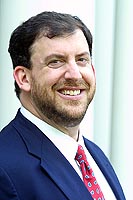
David Eisner Says Farewell

headshot_ceo_01_thumbDavid Eisner steps down as the CEO of the Corporation for National and Community Service.

(The Corporation is an independent organization established by the federal government that provides funds and accountability for AmeriCorps programs throughout the country.)

You can read his biography on the CNCS web site. And the transcript of the speech he delivered yesterday at Georgetown, “From Dropouts to Downturns — Why Service is America’s Solution.”

This letter was posted yesterday as a “thank you and farewell.”

Dear National Service Colleagues,

It feels strange to be stepping down as CEO of the Corporation at this time in the national service movement – like jumping off a train just as it is picking up speed! As I leave, I want to share just how much the work you all do has meant to me, how grateful I am to have had the privilege to represent you, and how confident I am about the future for the agency and for national service and volunteering in America.

As a result of our work together, today national service has improved more lives, grown stronger and more secure, expanded its base of bipartisan support, and built a culture of impact and accountability in a way that offers a solid foundation for continued growth. At the core of this movement are the citizens of America; individuals who are ready and willing to stand up and say “I care” when provided with the opportunity and the tools to do so. You are the leaders of this “I care” movement. As I mentioned in a speech to a group of idealistic Georgetown University students this morning, for five years I have traveled across the country with a mixture of awe and admiration at seeing how your work is saving lives, ensuring futures, defeating despair and restoring hope for Americans who have no other place to turn. Thank you for what you do and for letting me share a role in this amazing work.

Before I close, I want to share a few things about the individuals I leave behind at the Corporation for National and Community Service. The staff at the Corporation, both in headquarters in Washington, DC and across the country, are a top notch group of professionals who care more passionately about your success and the mission of national service than I could have ever believed possible before joining the Corporation myself. I am also indebted to Steve Goldsmith who chairs what may be the strongest and most effectively bipartisan board in Washington, DC, for his leadership, wisdom and support. Finally, I am grateful that Nicky Goren, my current Chief of Staff, will take over as Acting CEO with my departure. In Nicky you have an effective and experienced leader and champion for volunteering and national service.

If you would like to remain in touch with me, please feel free to contact my terrific assistant, Vickie Perry, for my personal email address. I will remain a cheerleader and champion for your work, and look forward to our paths crossing again.

Thank you,

David Eisner

GOOD Sheet on National Service

Have you seen this new series of sheets GOOD magazine has beengoodsheet_010_natlservice_em2 producing this year? They are folded up sheets of newsprint dedicated to a single topic. One I saw before the election was dedicated to close races — the kind where every vote counts.

This week’s is on service:

President Kennedy famously declared during his inauguration speech that we should ask ourselves what we can do for our country. National service takes many forms—from Americans deployed overseas to senior citizens teaching a new generation how to read. Now that the election is over, let’s continue the spirit of civic engagement. Find out what you can do for your country.

GOOD Magazine is a smart magazine (they assume you are smart, too — what a relief) that donates your magazine subscription fee to a nonprofit. Browse other GOOD Sheets.

CNCS: Student Service on the Rise, but Less Connected to Learning

New report shows fewer schools using effective education strategy

Wednesday The Corporation for National and Community Service released a new report showing that community service in U.S. schools has reached an all-time high. 68 percent of all K-12 schools offer or recognize some kind of service opportunities for their students but that service-learning is down.

The report, Community Service and Service-Learning in America’s Schools 2008 (PDF), found that while community service has increased in K-12 schools, the percentage of schools with service-learning declined from 32 percent in 1999 to 24 percent in 2008.

The study is the result of a survey of a national sample of more than 2,000 K-12 public school principals across the United States.  The results were released at the Academy for Education Development.

To view the full report and other information, visit www.NationalService.gov/research.

“This report comes at a critical time when our educational needs are great, our resources scarce, and our educators are searching for answers,” said David Eisner, the out-going CEO of the Corporation.  “The number of students failing to graduate is rising to epidemic proportions.  Yet we see that many schools are missing a key opportunity to use this proven strategy to help their students become more motivated and engaged both in and out of the classroom.”

The reason service in school matters at all is that research shows that introducing young people to service sets them on a path to lifelong civic engagement.  Tuft’s Center for Information and Research on Civic Learning and Engagement (CIRCLE) reports that volunteering empowers youth with the knowledge that they can make a difference in their communities.  Last year the Corporation published another report, Leveling the Path to Participation, that also found that youth from disadvantaged circumstances who volunteer feel more influential in their communities than do their peers who don’t volunteer.

One guess as to the decline in service-learning is that school leaders may falsely believe that service-learning only benefits a student’s civic achievement. In truth, research has shown that service-learning increases a child’s capacity to achieve academically as well—by deepening the learning experience and diminishing negative behaviors.

Other key findings of the study include:

  • The majority of school districts do not provide service-learning policies, according to school principals.  Only 19 percent of school principals report that their districts have a policy that promotes service-learning, and 28 percent of principals do not know whether their district has such a policy.
  • Elementary schools are the least likely to offer service-learning activities.  20 percent of elementary schools have service-learning programs, compared to a quarter of middle schools and over a third (35%) of high schools.  Furthermore, over half (51%) of elementary school principals believe their students are too young to engage in service-learning.
  • The class gap in service learning is decreasing but still exists.  Schools in low-income areas are significantly less likely to have service-learning activities than other schools.  In 1999, schools in low-income areas were 57 percent less likely to have service-learning activities; in 2008 they were only 35 percent less likely to offer service-learning.  Still, only 20 percent of schools in low-income areas currently offer service-learning activities compared to 27 percent of schools that are not in low-income areas.

Obamas, Public Allies in the Spotlight

Service program receives more, positive, media attention while solving tough social problems for communities and offering professional growth for corps members.

logo

Public Allies has received a lot of tough press among obscure blogs this year, but with established connections to the future President and First-Lady, the outlook in the media has just gotten brighter for the national, Milwaukee-based AmeriCorps program.

Here are just a couple news items involving Public Allies in the past week since the election:

The National Public Radio show Morning Edition mentioned Public Allies this morning in a discussion of Michelle Obama’s executive experience since graduating from law school. She was the founding Executive Director of Public Allies Chicago.

The San Francisco Chronicle published this article about social entrepreneurs’s hopes for the new administration. The New York Post ran an article on Michelle Obama.

Michelle Obama chatted last week with a Newsweek journalist about her experience with Public Allies and the future of national service generally:

[Richard Wolffe:] You want to continue what you did with Public Allies (which trains young people to become leaders of community groups and nonprofits) as First Lady. What’s your thinking on how to go about that?

images[Michelle Obama:] Barack is talking about a deeper investment in national service; that’s been part of his platform. He’s been meeting with some of the leadership of the AmeriCorps national-service movements—the Public Allies, the Teach for Americas, the City Years of the World—and figuring out how do we use that model, expand upon it, and help use that as a more creative way to defray the costs of college for young people and get all Americans really engaged. What AmeriCorps showed me, during the time that I worked on it, is that all these resources of young people, and not-so-young people, as I call them—because AmeriCorps is not just for young adults but people of all ages—you can fill a lot of gaps with the help of community-service hours. The young people in my program worked as program directors. They worked with kids and they worked in parks and they worked with nonprofit organizations that didn’t have the resources to bring people in full time. So this is one of those clear win-wins. You can help kids pay for school, you can get needed man-hours into really critical things like the environment, senior care, Head Start—a whole range of things. And you get the country more focused on giving back.

Earlier this year, Fast Company named Public Allies and its President and CEO Paul Schmitz one of the top 45 Social Entrepreneurs Who Are Changing the World.

11/12/08 an article about Public Allies appeared in the Pittsburgh Post-Gazette.

11/13/08 in Canada’s National Post.

What is Public Allies?

Public Allies is a 10-month service and leadership program that serves in 15 cities across the United States.  Corps members — called “Allies” — serve with nonprofits and universities to “create, improve and expand services that address diverse issues, including youth development, education, public health, economic development and the environment.”

The monthly stipend (at $1300-$1800) is higher than many AmeriCorps programs, and Allies are eligible for the $4725 AmeriCorps education award at the end of the term. But the best benefit of the program may be its extraordinary training opportunities. This, from the Public Allies web site:

A rigorous leadership development curriculum delivered by community leaders, practitioners and educators, which includes:

  • Intensive weekly skill training and leadership development seminars
  • Critical feedback, reflection, and personal coaching toward individual performance and professional goals
  • Community building and team projects with a diverse cohort of peers
  • Presentations of learning at the end of the year to demonstrate how one met the learning outcomes of the program

Good news for Public Allies and for national service

Not only Public Allies stands to benefit from the media attention, but national service as a whole does as well, including efforts like Service Nation, the campaign for expanded funding for service.

Besides the media attention, no president has had as much direct experience with the challenges and opportunities of national service as President-Elect Obama, who was a founding board member of Public Allies Chicago. He stepped down from his board post before Michelle Obama joined as staff.

Read more

Read more about applying to Public Allies, its distinguished alumni network, hiring a graduating Ally for your organization, hosting an Ally at your organization, and the program’s legacy of achievement.

On Michelle Obama and Public Allies, check out the Public Allies factsheet, and look for this year’s Michelle: A Biography by Liza Mundy at your local library.

Michelle Obama talks about AmeriCorps

In a post-election interview with Newsweek, Michelle Obama talks about potential expansion to AmeriCorps and national service, as well as her association with Public Allies. Again, with the economy such an issue, it’s great to see that national service isn’t getting placed on the back burner!

(See also this post about Public Allies press coverage since the election.)