Protect Your Clients’s Right to Vote and Your Own

Are you or your organization’s clients at higher risk for being challenged at the polling station November 4th? (See the end of this post for a list of people who are more likely disenfranchised.)

If so, you and they should be prepared. Election Protection offers a state-by-state run down of election policies and laws. They also encourage you to call 1-866-OUR-VOTE for legal support if you find yourself being challenged at the polling station.

Investigative journalist Greg Palast and Bobby Kennedy, Jr., have recently published a comic book called Steal Back Your Vote to educate voters about what to do in case their right to vote is challenged on Election Day. (Note: the comic book may be nonpartisan but not all of its sponsors are.)

They offer these tips:

  1. If you can avoid it, don’t mail in your ballot because mail-in ballots are more likely to be discounted and may even arrive too late to cast by election day. (In Oregon, all ballots are mail-in which actually seems to solve problems other states have faced in terms of presenting photo ID, lacking sufficient voting machines to accommodate all voters, etc.) If you are a Peace Corps Volunteer, Military service member, or other U.S. citizen living abroad, you have the right to vote absentee or through a “back-up ballot.”
  2. Vote early so that if your vote is challenged, you have time to correct the problem. According to Palast and Kennedy, “Every state now lets voters cast ballots in designated polling stations and at county offices in the weeks before Election Day.”
  3. Check your registration status. And help register others to vote.
  4. Instead of accepting a provisional ballot at the polling station, “demand adjudication from poll judges on the spot; demand a call to the supervisor of elections; or return with acceptable ID if possible.” Also, defend the rights of others as a poll watcher. (You can also volunteer to work the polls. If you have legal training, you can volunteer to protect voters at the polls.) Call Election Protection at 1-866-OUR-VOTE if you run into trouble. Provisional ballots, according to the comic book authors, are too often thrown out.
  5. Take action by registering people to vote and volunteering.
  6. Go to the polling station in a group which may empower you to stand up for your right to cast a ballot.

People most likely to be disenfranchised include the following (many which could describe term of service participants and their clients):

  • Renters/people who move around more often
  • People with low incomes
  • People of color
  • People who don’t drive and therefore don’t have a government-issued ID card
  • Elderly people, people with disabilities, people who are living abroad, and others who can’t get to the polls on Election Day
  • People who haven’t voted in awhile
  • People who are voting for the first time

Am I missing any? Leave a comment and I will update.

Also read about permitted contact between 501(c)(3) organizations and partisan contact in voter protection.
AmeriCorps for Recent Public Interest Law Grads

Corps of recent law grads bring legal services to the poor

Equal Justice Works, an organization that fosters the public interest law career pipeline so the rest of us can sleep better at night, has recently sent off its newest AmeriCorps team to serve in 17 sites across the United States.

The Equal Justice Works AmeriCorps Program acts to increase the availability of pro bono legal services in under-served communities. The program achieves its goal by engaging recent law school graduates, who connect the dots among legal aid workers, law schools, law students, and clients in need.

The AmeriCorps members also offer legal assistance to low-income clients, and thereby hone their skills practicing public interest law. They also help expand the public interest law emphasis in law school course content and offerings.

At $22K, the AmeriCorps stipend for the Equal Justice Works member is significantly higher than for most AmeriCorps programs. With the possibility of student loan deferments and the $4,725 Eli Segal AmeriCorps Education Award, participating in the program post-law school isn’t as costly as it seems at first glance. The program also connects participants with 500,000 other AmeriCorps Alums post-service.

Summer Corps

In addition to the year-long AmeriCorps program, Equal Justice Works organizes an AmeriCorps-funded Summer Corps for first- and second-year law students. The Summer Corps engages hundreds of short-term members in 300 hours of service. Members then receive a $1000 education award. Look for applications in the spring.

Equal Justice Works Fellows

Finally, check out the two-year Equal Justice Works Fellowship for law grads, which offers new lawyers support (financial and professional) to practice public interest law. According to the web site, “Recognizing that many obstacles prevent committed attorneys from practicing public interest law, including the dearth of entry-level jobs and daunting educational debts, the program provides financial and technical support to lawyers working on innovative and effective legal projects.”

Public interest law

To learn more about careers in public interest law, and to learn about law school, check out Equal Justice Work’s web site, and its E-Guide to Public Service at America’s Law Schools. Keep up with the latest news and trends in public interest law, law education, and EJW by subscribing to the Equal Justice Works blog.

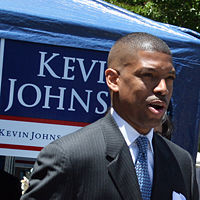
Yikes! Kevin Johnson and AmeriCorps Prohibited Activities

Update June 12, 2009: Check out this article from Youth Today, for background information on the connection between the Kevin Johnson controversy and CNCS’s Inspector General Gerald Walpin, removed from his position by Obama this week.

Sometimes site supervisors who host AmeriCorps members don’t quite get it

Kevin Johnson, former Phoenix Suns point guard, is in trouble with the Corporation for National and Community Service.

According to the LA Times, the Corporation is suspending funding for St. HOPE Academy’s Neighborhood Corps pending allegations that its AmeriCorps members have been instructed to take part in  activities outside the scope of the program’s contract with the Corporation. Johnson founded the organization 19 years ago, and stepped down as CEO in June to devote energy to his mayoral campaign.

The LA Times reports that Johnson allegedly enlisted AmeriCorps members to wash his car and drive him to appointments, among other menial tasks that AmeriCorps members are not only not funded to do, but are usually annoyed when asked to do.

An AmeriCorps member is similar to a human resource grant, and as with a monetary grant, must be engaged according to the grant’s guidelines. When organizations write a grant proposal to request funding for AmeriCorps members, they must spell out clearly what the members will spend their time doing. The Corporation also has very specific focus areas that it funds, such as mobilizing volunteers, and bringing postive changes to the lives of children and youth through mentoring and tutoring.

(Further, all AmeriCorps members are prohibited from providing direct benefit to a partisan political organization, attempting to influence legislation, organizing or engaging in protests, participating in union organizing, and other things.)

Occasionally, an AmeriCorps member’s supervisor or colleague doesn’t understand the restrictions of a member’s service. In these cases, members (or AmeriCorps program staff) have to clarify these boundaries with the agencies they serve with and for. A classic example is an officemate who asks an AmeriCorps member to make photocopies for projects unrelated to the member’s service.

Usually the request is made innocently enough, because the staff member isn’t educated about the perameters of AmeriCorps service.

But it’s a tough position for the AmeriCorps member to be in, because they often like and respect their colleagues, want a good reference from the host agency, and want to be a team player.

Johnson, who has won awards for his community service achievements, is running for mayor in Sacramento, his hometown.

Neighborhood (or Hood) Corps’ mission is to empower youth and to “recruit, train and mobilize young adults to become civic leaders committed to revitalizing inner-city communities” as an alternative to gang participation. Despite the controversy, it is an example of a program that transforms the lives of the AmeriCorps members as much as it transforms the lives of its clients.

11/05/08 Update: Kevin Johnson won the Sacramento mayoral race.

Building strong ties to local college career centers

Your service corps program and your Corps members can benefit from a good relationship with local college and university career services offices.

This afternoon I have the honor of working with directors of Oregon’s AmeriCorps and AmeriCorps*VISTA programs around the topic of career transitions for Corps members. One message I want to drive home is that developing ties to local career centers can help both with recruitment of new Corps members, and also helping current members with their next steps. Here are some ideas:

Getting Started: Invite career center staff from local colleges and universities for a brown bag lunch in your office to share resources and compare complementary needs. Some schools are part of a consortium that hold regular meetings; you could ask about presenting at one of these meetings. Some career centers have a counselor who focuses on public service; when you make your first call, you might ask for that person.

Be a presence (not just a flyer) on campus when it’s time to recruit: Staff tables at the school’s career fair, and let the career counselors know that you are available to speak at panel and round table discussions. Ask if there is a way to post your general and recruitment information on the career center’s website or resource library, or to staff a general information table on campus. (Idealist.org also organizes nonprofit career fairs hosted by career centers on college campuses throughout the United States.)

Be a resource on national service: Work with the career counselors to put together a panel on national service opportunities for college students. Help find current or former AmeriCorps, AmeriCorps*VISTA, and NCCC members, Jesuit Volunteers, Jewish Coalition for Service program participants, Peace Corps Volunteers, Teach For America, Public Allies, or City Year Corps members (seek people from a variety of service programs) to speak on a panel discussion, to help clarify college students’ options and understanding of the differences among the programs. Students may not understand how to apply to a program, or may be confused about the de-centralized application process for some programs. Be ready to offer guidance at least for your program!

Educate counselors about the benefits of national service: Let career counselors know that for some graduating or even gap-year students, doing a year of national service is a really good way to serve your community in a more concentrated, intense way than you may be able to through traditional, episodic volunteering. It’s also proven to be a  launching point for a public service career. Students looking for a year of work experience before going to graduate school will benefit from serving – often with a high level of autonomy, challenge, and responsibility – for an organization that doesn’t expect a long-term commitment. If they can think of the term-of-service as a fifth and/or sixth college year – during which the students serve the community, learn tuition-free, and may not have to pay student loans – the investment makes more sense. Not to mention the networking and the educational benefits!

Exchange career transitions support: As you develop relationships with career centers in your area, you might:
•    Ask if Corps members can attend resume and other workshops at the career center.
•    Arrange for college students to shadow Corps members for a day; establish a list of members who would be open to informational interviews and share it with career office contacts; invite college students on community service projects.
•    Offer for you and your Corps members to play the “employers” for mock interviews with college students – it is a great exercise for your members to be on the hiring side of an interview process.

Find more career resources for national service members on Encorps‘s Beyond the Service Year and What’s Next, and on Idealist.org through the career center, career guides, and Term-of-Service page.

This blog post has been adapted from a section of the forthcoming Service Corps Companion to the Idealist.org Guide to Nonprofit Careers, due out this coming spring from Idealist.org.