If you served with AmeriCorps or VISTA within the last three years and are looking for an opportunity to further explore and promote national service, learn more about the Eli Segal Fellowship. The position is located in Washington DC, it’s a 10-12 month term, and comes with pay and benefits. The deadline is October 6, 2008.
Category Archives: Advice
This blog features several types of advice, such as careers and grad school.
The Grad School Campus Visit
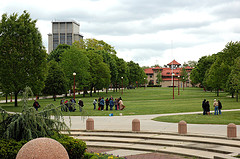 Top things to know when you are shopping for schools
I don’t travel to as many of our Idealist.org graduate admissions fairs as I used to, but when I do I love to hear from admissions staff who table at the events about their day-to-day activities back at school. Over time I have had quite a few conversations about the Campus Visit and wanted to share some nuggets of wisdom here.
Visiting the admissions office:
One recent discussion was with Emmett Griffin of Georgetown Public Policy Institute about prospective students’s visits to his office. These are his tips:
As with any professional encounter, it’s wise to make an appointment with an admissions officer, a week ahead of time if possible. Admissions staff are busy. You’ll make a much better first impression if you set up a time to meet, and they are expecting you.
Read before you go. Of course you want to ask a lot of questions. But before asking anything of a school’s faculty or staff, read the web site and/or any available print material. Those will likely answer a lot of your questions, and you’ll make a better first impression if you have done your homework (this is, er, school, after all). (Imagine if you had a job where you were constantly asked questions — wouldn’t you answer all the most common questions on your web site and in your brochures?)
What if you happen to be visiting a city for other reasons and decide to drop by campus for an unannounced visit? Still call ahead, even if it’s just an hour ahead — and read as much as you can, even if it’s skimming all you can get your hands on in the admissions office itself, before chatting with an admissions officer.
Visiting classes:
The tips below are from conversations with Idealist’s Graduate Admissions Advisory Board (of which Emmett Griffin is a member):
Consider visiting a class or two while you are on campus. But do not show up to a class unannounced. Schools love for prospective students to sit in on a class or two and will have different policies about how to set up the class visit.
Contact your target school’s admissions office, or the department. Sometimes you can sign up for a class visit right on the web site, other times the admissions office will direct you to the registrar or individual professor.
Also, professors might want you to have read some course materials ahead of time and expect you to participate in class discussions. Find out about these expectations ahead of time, if possible.
Other activities while you are on campus:
• Talk with someone in the career center about internship and career transitions support (grad schools often have their own career office)
• Meet with a current student to ask what it’s like to be a student there (see this article about informational interviews)
• Participate in a campus tour; many schools offer these a few times per day. The admissions office can let you know the details
Before you go, write a list of questions and/or considerations you’d like to keep in mind on the day of your visit. It might also be a good idea to jot down your top priorities in a school so you can objectively evaluate your experience later on. For example, if you intend to use the athletic facilities, you’d want to make sure you get to see them and find out how much (if anything) it costs to use them. You might be looking for an academically rigorous environment, or a lot of support setting up excellent internships.
Reflection:
When you get home, reflect on your list of questions:
√ What did I learn?
√ How interested am I in exploring this academic program further?
√ What values, skills, and interests of mine fit – or don’t fit – with the degree, department, or student culture?
√ What are my next steps from here?
Thanks:
After you visit, send thank-you notes to the professors, students and staff you met with. You can have the thank-you notes stamped, addressed and ready to go (save for writing the note itself) when you arrive on campus. As your last stop on campus, take a few minutes over coffee or lunch to write the notes, and pop them in the nearest mail box. The important thing is to make the note meaningful, and to state something specific you learned. If possible, enclose your business card in the envelope.
Read more about grad school choices, admissions, and financial aid.
Find an Idealist.org Graduate Degree Fair for the Public Good in a city near you. (We are only going to 18 cities this year — we are genuinely sorry if we miss yours.) We’re coming to Philadelphia Monday 9/22, then off to the West Coast!
Blog for us (deadline extended).
Building strong ties to local college career centers
Your service corps program and your Corps members can benefit from a good relationship with local college and university career services offices.
This afternoon I have the honor of working with directors of Oregon’s AmeriCorps and AmeriCorps*VISTA programs around the topic of career transitions for Corps members. One message I want to drive home is that developing ties to local career centers can help both with recruitment of new Corps members, and also helping current members with their next steps. Here are some ideas:
Getting Started: Invite career center staff from local colleges and universities for a brown bag lunch in your office to share resources and compare complementary needs. Some schools are part of a consortium that hold regular meetings; you could ask about presenting at one of these meetings. Some career centers have a counselor who focuses on public service; when you make your first call, you might ask for that person.
Be a presence (not just a flyer) on campus when it’s time to recruit: Staff tables at the school’s career fair, and let the career counselors know that you are available to speak at panel and round table discussions. Ask if there is a way to post your general and recruitment information on the career center’s website or resource library, or to staff a general information table on campus. (Idealist.org also organizes nonprofit career fairs hosted by career centers on college campuses throughout the United States.)
Be a resource on national service: Work with the career counselors to put together a panel on national service opportunities for college students. Help find current or former AmeriCorps, AmeriCorps*VISTA, and NCCC members, Jesuit Volunteers, Jewish Coalition for Service program participants, Peace Corps Volunteers, Teach For America, Public Allies, or City Year Corps members (seek people from a variety of service programs) to speak on a panel discussion, to help clarify college students’ options and understanding of the differences among the programs. Students may not understand how to apply to a program, or may be confused about the de-centralized application process for some programs. Be ready to offer guidance at least for your program!
Educate counselors about the benefits of national service: Let career counselors know that for some graduating or even gap-year students, doing a year of national service is a really good way to serve your community in a more concentrated, intense way than you may be able to through traditional, episodic volunteering. It’s also proven to be a launching point for a public service career. Students looking for a year of work experience before going to graduate school will benefit from serving – often with a high level of autonomy, challenge, and responsibility – for an organization that doesn’t expect a long-term commitment. If they can think of the term-of-service as a fifth and/or sixth college year – during which the students serve the community, learn tuition-free, and may not have to pay student loans – the investment makes more sense. Not to mention the networking and the educational benefits!
Exchange career transitions support: As you develop relationships with career centers in your area, you might:
• Ask if Corps members can attend resume and other workshops at the career center.
• Arrange for college students to shadow Corps members for a day; establish a list of members who would be open to informational interviews and share it with career office contacts; invite college students on community service projects.
• Offer for you and your Corps members to play the “employers” for mock interviews with college students – it is a great exercise for your members to be on the hiring side of an interview process.
Find more career resources for national service members on Encorps‘s Beyond the Service Year and What’s Next, and on Idealist.org through the career center, career guides, and Term-of-Service page.
This blog post has been adapted from a section of the forthcoming Service Corps Companion to the Idealist.org Guide to Nonprofit Careers, due out this coming spring from Idealist.org.
How to find grad schools
Even the savviest, most passionate grad school seeker may get a crush on one or two famous grad schools, and have a hard time generating a “long list.”
But most admissions professionals will tell you it’s a good idea to apply to several schools (including—eek, I hate to say it—”safety” schools) to be sure you get in somewhere. I am not sure that I agree—you may want to work for a few more years in your field and apply again to your top choice schools when you are more established.
However, in case it’s useful, here are the main ways of fleshing out your list of prospective schools:
1. Attend the Idealist.org Graduate Degree Fair for the Public Good or another graduate admissions fair in a city near you. No, this isn’t a commercial, it really is a good way to find schools. If you go to a fair, I challenge you to approach at least three schools that you haven’t heard of, or you wouldn’t think of applying to. Let the admissions professional know your plans for the future, and see if they surprise you.
This week: Toronto (9/18) and Washington, DC (9/19). Next week, Philadelphia (9/22). See the rest of the season schedule here.
2. Informational interviewing. Talk with professors and professionals in your field, and find out how they got where they are now, if they even went to grad school, and where they would suggest you go.
3. School associations! Many different types of schools, from international affairs to business, are affiliated with an association of similar schools. You can learn about many different programs and the degree itself through the association. We don’t have a list of school associations online that I can link to (I will work on that) but do take a look at our grad fair cosponsors, which include many types. Other school groupings include schools that offer to match the AmeriCorps Ed Award, and schools that partner with Teach For America or Peace Corps to extend benefits to participants.
4. Conversations with graduate admissions personnel, who are well-versed in the characteristics of peer schools. Some schools’s admissions staff even travel and attend recruiting events together regularly. Whenever you have a chance to speak with admissions officers, share with them what you are looking for in your ideal school or degree. They should be able to let you know what other schools to look into, and whether or not their school is a good fit for you. If their school is a good fit, be sure to ask for guidance in navigating the application and admissions process.
5. Research online through sites like Peterson’s, Gradschools.com, and Idealist.org (we hope to launch a directory of public interest grad schools in 2009, but for now, search for “organizations” using key words like “graduate school,” “social work,” “MPA,” etc.)
Best of luck, and read more about grad school on our Public Service Graduate Education Resource Center!
Those pesky student loans
Amy is off to New York to see Obama, McCain, and maybe President Clinton at the Service Nation Summit, while I’m stuck in Portland contemplating the nuances of financial aid. At the least the weather is as close to perfect as can be.
I learned more about the Public Service Loan Forgiveness program. That’s the new law that allows people working at nonprofits to have their student loans forgiven after 10 years of steady payments, starting from October 2007. (One of the catches is that you need to have Direct Loans, but if you don’t, you can consolidate.)
For me the downside of the program is that if you don’t have huge loans, at the end of ten years of steady payments there won’t be much of a balance to be forgiven. Still, getting any student loan balance off the books is a wonderful thing and should be taken advantage of.
But then I learned about another program called Income-Based Repayment, with huge implications for AmeriCorps and VISTA members, as well as others earning low pay while working in the nonprofit sector.
It comes online in July 2009.
In a nutshell, the Income-Based Repayment program sets your loan repayment amount at a rate of 15 percent of your discretionary income. Without getting too much into the math, if you are below the poverty line, your payments could be $0 per month. Sure interest will accrue, but the idea is if you serve in AmeriCorps or VISTA for a year or two and hold a low-paying nonprofit job for the next nine or ten years, you could get your entire loan debt erased without making a single payment in that time. (You should check the list of qualifying loans. If you don’t have them, consider consolidating.)
The trick with either one of these programs is to start planning now if you think you might be taking advantage of these programs.
I will write more later about the pros and cons of the Income-Based Repayment program vs. the forbearance CNCS offers to AmeriCorps and VISTA members.
Update 11/07, from Put Barber, Senior Researcher at Idealist.org:
The Department of Education has published final regulations for the College Cost Reduction and Access Act of 2007 (CCRAA). This Act provides for loan forgiveness for full time employees of “public service organizations.” Nonprofit full-time employees (at least 30 hours a week) who are making monthly college loan repayments can count each month of nonprofit employment towards the 120 months of payments needed to qualify for forgiveness of the remaining loan balance, beginning with payments after October 1, 2007. Current nonprofit employees with outstanding student loans of more than nine years future duration can look forward to an end to the loan payments in after about nine more years of work for nonprofits.
The National Council of Nonprofit Organizations (NCNA), along with other national groups, worked throughout the rule-drafting process to extend this provision to employees of all 501(c)(3) organizations. For more information, see a Q & A on the NCNA website.
 The New Service