A Socially Networked Administration

Blogging for Mashable.com, Adam Ostrow offers several suggestions for how Obama’s administration can continue to use its well-established social networks during the next four years and beyond.

Most of his ideas include keeping Obama’s base civically engaged—educating them about legislation that needs congressional support, and calling citizens to service:

Obama has often talked about a call to service during his campaign – things like expanding the Peace Corps and offering tax credits in exchange for public service. Why not allow users of MyBarackObama to utilize the platform to organize community service projects? Use Twitter and SMS to alert people to opportunities to give back in their own communities or when national tragedy strikes. Utilize Facebook to get the word out about charitable events. The tools and the users are already in place.

Rather than requiring people to be so proactive about doing good, Obama’s social media reach allows them to be reactive – staying informed of things going on in their communities, organizing people that can help, and then pitching in – all from the comfort of their personal computer.

I feel old saying this, but there was a time not so long ago when presidents wouldn’t even appear on night-time talk shows. What do you think of a President who keeps a blog, whom you can support on Facebook and who can follow you on Twitter?

How else can we capture the energy left in the wake of the election, where Democrats and Republicans mobilized to the mantra of “change”?

See this post about Obama’s plans for his social network.

Also check out this article on the implications of Obama’s online campaign for the social sector, by Tom Watson, author of CauseWired: Plugging In, Getting Involved, Changing the World and publisher of OnPhilanthropy.

RPCVs ask Obama for More Peace Corps

Today the National Peace Corps Association (NPCA) launches a petition to seek Peace Corps expansion under the new Obama administration.

The independent nonprofit group of Returned Peace Corps Volunteers is asking supporters to sign a petition to advocate for the growth and strengthening of Peace Corps.

With the election of Barack Obama as the 44th President of the United States, the National Peace Corps Association and its MorePeaceCorps campaign has launched an on-line petition urging support for a bigger, better and bolder Peace Corps.  The petition is addressed to President-elect Obama, and will be presented to the Obama transition team.  We also plan to use the petition as a way of showing critical state and congressional district support during meetings in the coming months with Capitol Hill lawmakers. Take action right now, right here.

Read more about Obama’s pre-election stance on service corps programs.

Read more about the MorePeaceCorps campaign. Read Barack Obama’s letter to RPCVs in the fall 2008 issue of World View Magazine.

Barack Obama is arguably one of the most internationalist presidents in U.S. history, his father having come from Kenya; some of his elementary school years spent in Jakarta.

Pres. Obama and Government Careers

images-4With record numbers of first-time voters and young people backing Obama’s presidency, perhaps a new generation of government workers will not be so hard to recruit after all.

With Baby Boomers retiring in droves over the next decade, fears have been widespread in public and nonprofit sectors that the United States will face a leadership shortage.

Not enough young people have shown an interest in government careers, and in-roads to government careers are not well known. Government has a reputation of being inefficient, less lucrative than business sector work, and very, very bureaucratic. People cite student loans that are just too high, and the need for better marketing of the compelling opportunities available in the government.

“This will not be a call issued in one speech or one program – this will be a central cause of my presidency. We will ask Americans to serve. We will create new opportunities for Americans to serve. And we will direct that service to our most pressing national challenges.”– U.S. President-Elect Barack Obama during a speech given at the University of Colorado, Colorado Springs July 2, 2008.

John F. Kennedy inspired a generation of youth to serve through initiatives like Peace Corps. Will a new generation of people — young people and people who are recently discovering civic engagement — be inspired to join the ranks of an Obama-led federal government? What do you think?

If you are considering a career in government — whether you supported McCain or Obama during this election cycle — you should know about these resources:

President-Elect Obama has been particularly clear that his administration will count on the help of people who have supported his candidacy and on those who didn’t. Young people may accept this invitation by entering the government workforce. If they do so with the enthusiasm and turn-out they have shown in his election bid, the looming leadership crisis may fail to materialize.

Peace Corps China – Teaching future teachers

Volunteers teach college-level English in China’s interior for two years, including a summer of intense training. Livable monthly stipend, top-notch health benefits, Mandarin language education, network of other volunteers throughout the Southwest.

Peace Corps’s China program is one of my alma maters, and is a recruitment priority right now for Peace Corps. So I am sneaking it in as part of this week’s focus on teaching corps. Read about Peace Corps’s education programs more broadly.

Next week (Nov. 8th) my friend and China RPCV Kate Kuykendall, a public affairs specialist for the L.A. recruitment office, will host an Online Info Session about Peace Corps China that you can tune into for even more information.

A word about teaching English

The notion of teaching English doesn’t seem as glam as other overseas volunteer assignments like business or public health.

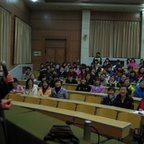
Chinese lecture hall, by Alison

Chinese lecture hall, by Alison

But English is a skill that people from the United States tend to have, and that other countries want for their youth. If you are looking to contribute to the development of other countries and build the capacity of young people there, English is a skill you can export and feel good about.

The other thing about teaching English is that right from the start of your term, before you can speak well in their language, your students can serve as insightful cultural informants to help you navigate your new life. Read about teaching English in China with Peace Corps.

Pre-service training

Trainees in the China program live in homestays during the two months of pre-service training, learn how to effectively teach English to large groups of students, study Chinese language in small groups with exceptional teachers, learn how to stay healthy (i.e., don’t drink unboiled water, what to do in case of unmentionable stomach ailments, etc.), receive scheduled immunization shots, and at the end of the summer, are sworn in as Peace Corps Volunteers.

Placement

Volunteers serve in teachers colleges in the interior of China, and teach classes of 40-60 students at a time.

English library, photo by Alison

English library, photo by Alison

Subjects  include English literacy, conversation, and  British and U.S. literature and culture.  The work week includes several courses, office hours, and often a teacher-hazing ritual called “English Corner.” Students typically come from very poor, rural areas, with plans to return home to teach English at the middle-school level. Colleges in China are more likely to be in cities, so China placements tend to be urban, where Volunteers live rent-free in modestly furnished campus apartments. Read some basics about living in China.

Benefits

A large Chinese kitchen, photo by Alison

A large Chinese kitchen, photo by Alison

Benefits of Peace Corps service — other than that your understanding of the world is enriched forever — include airfare to and from your country of service, health care (including prescription and over the counter medicines, yearly exams, evacuation home if the medical attention you need is not available in-country), a monthly stipend that is on par with that of locals, two vacation days per month (plus local holidays and weekends), reimbursement and per diem for all service-related travel, and just over $6,000 disbursed to you when your term of service ends.

If natural disaster, political unrest, plague, etc. make your stay in China untenable, Peace Corps will evacuate you and your group. Read more about the recent closing of the Bolivia program. In 2003, the Peace Corps China program was completely emptied out in response to the SARS epidemic.

In addition to pre-service language training, Peace Corps reimburses you the expense of on-going private language instruction once you are at your service placement. A few times a year you have the opportunity to head to trainings at Peace Corps country headquarters (in China, this is located in Chengdu, Sichuan, very near the May earthquake epicenter).

heping dui, photo by Alison

heping dui, photo by Alison

Educational benefits include deferring qualified student loans during your term of service (and partial cancellation of Perkins loans). Once you are back, you are eligible to apply for special fellowships at grad schools through the Fellows USA program, especially designed for Returned Peace Corps Volunteers (RPCVs). (For people who have not yet joined Peace Corps, also consider Peace Corps Masters International, which allows you to do Peace Corps service as part of a master’s degree). Read more and listen to a podcast on Peace Corps and grad school.

Peace Corps China journalists

No discussion of Peace Corps’s China program would be complete without mentioning the journalists who have graduated from it. While most China RPCVs have gone on to do great things in many fields, the group has produced several noteworthy writers and journalists.

Pete and a Chinese man, photo by Mark Leong

Pete and a Chinese man, photo by Mark Leong

These men’s voices weigh in on our understanding of China. They are helping people in the U.S. create a new consciousness of China, about the complexities of its culture, its conflicting priorities as it develops. The value of their contribution lies in their knowledge of the language, people, and context of China with a depth the U.S. reader hasn’t seen since missionary-era writers like Pearl Buck.

The emphasis Peace Corps China has traditionally placed on friendship (the Chinese name for the group is the Sino-U.S. Friendship Volunteers), cross-cultural and cross-linguistic understanding, produces a wider lens through which to view the nation and its billion-plus people — a lens some other journalists in China simply haven’t had.

It’s not that these journalists are apologists for the unsavory things the Chinese government does. But we aren’t going to learn anything about China, or any country, if we look only at the actions of a government and never at the people themselves… If we only listen to press conferences and never to the voices of the farmer or factory worker.

Multimedia

The independent Peace Corps Wiki is an alternative source of information about Peace Corps. Here’s the China wiki.

Read the online journal entries of Michelle Ross who served in China from 2006-08, and listings of other Peace Corps China blogs.

Check out this Google presentation featuring China RPCV Pete Hessler speaking about his writing and experiences in Peace Corps.

Check out the official Peace Corps Video Vault, where Volunteers speak to some of the most frequently-asked questions Peace Corps applicants have.

Resources

And a repeat: Next week (11/8) my friend and China RPCV Kate Kuykendall, a public affairs specialist for the L.A. recruitment office, will host an Online Info Session about Peace Corps China that you can tune into for even more information.

For more resources on graduate education, check out the Idealist.org Public Service Graduate Education Resource Center, and if you live in the vicinity of Georgia, come to our final graduate admissions fair coming to Atlanta on Monday, 11/3.

This week The New Service blog is looking at education service corps. While many service corps programs have application due dates in the spring for a fall start date, most education service corps have deadlines throughout the winter and start in the summer. Check out this list of education-related opprotunities that don’t require an education degree.

Agency Director Proposes Peace Corps Foundation

Peace Corps Director and Returned Peace Corps Volunteer (RPCV) Ron Tschetter today proposed the creation of an independent Peace Corps Foundation.

Since the inception of Peace Corps during the Kennedy administration, the agency has had three goals. The third goal has been to bring the world back home. The vision of the Peace Corps Foundation to support educating people in the United States about Peace Corps host countries and cultures.

This is from the press release issued by Peace Corps on Oct. 24:

Describing the idea during a town hall staff meeting, Director Tschetter said, “The Peace Corps Foundation would foster greater participation and support to Returned Peace Corps Volunteers and their organizations, encourage cross-cultural exchange, volunteerism through community events, classroom visits, and other educational activities. We now seek support and authority from Congress on this key priority for our agency, and I look forward to moving ahead on this initiative as soon as possible.”

“Groups such as the National Peace Corps Association and the numerous ‘friends of’ groups comprised of Returned Volunteers could greatly benefit from Foundation resources…

Ultimately, a Peace Corps Foundation building in Washington D.C. would serve as an educational facility where Americans, particularly children, would come and learn more about other cultures and countries, as well as how the Peace Corps fulfills its mission of promoting peace and friendship worldwide. The Foundation would also complement the Peace Corps’ Third Goal activities such as Peace Corps Week, the Coverdell World Wise Schools Program, and the publication of educational materials for teachers and students.”

Peace Corps Week takes place in the late winter and encourages RPCVs to speak about their cross cultural experiences in their communities and local class rooms.

World Wise Schools allows classrooms to adopt currently serving Peace Corps Volunteers as correspondents.

RPCVs and National Peace Corps Assocation-affiliated RPCV groups will likely greet the news of support for Third Goal activities with hope and curiosity.

Many groups work hard to make connections between their host countries and the United States, for example, members of the Columbia River Peace Corps Association in the Portland, OR, area have been working hard for years to launch the Museum of the Peace Corps Experience.

These are the three goals:

  1. Helping the people of interested countries in meeting their need for trained men and women.
  2. Helping promote a better understanding of Americans on the part of the peoples served.
  3. Helping promote a better understanding of other peoples on the part of Americans.