The British Council Creates Global Connections and Impact Through Dialogue and Service

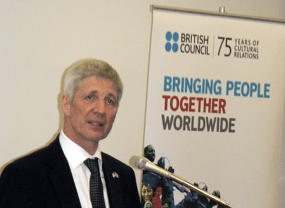
Professor Mike Hardy

Professor Mike Hardy, Photo by Kate Anderson

Amy Potthast first wrote about the British Council’s event and because I live in the nation’s capital, where the event was held, I had the good fortune of attending.

Admittedly, I was still reeling from Michelle Obama’s visit to CNCS — so the British Council event was yet another highlight on my calendar which made that week unforgettable, to say the least.

An impressive crowd gathered—approximately 50 attendants—at the Rayburn House Office Building for what was absolutely a lovely affair.  Lovely is not a word I usually use to describe a professional engagement, but I think this word comes to mind because of my British, or as I say, Bree-teesh, bias. Yes, I’m a sap for their accents and covet their seemingly inborn urbane manner.

Prior to the event, I was only loosely familiar with the work of the British Council—the United Kingdom’s international Continue reading

Med School Tuition Help for Former Corps Members

601TV's Flickr StreamIn response to the projected shortage of doctors in the coming decades, and the prohibitive costs of medical education, Rep. Michael McMahon (D-NY) has introduced a bill to make medical school affordable for former civilian service corps participants.

The Future Physicians Serving America Act of 2009, co-sponsored by Rep. Gerry Connolly (D-VA) and Rep. John Sarbanes (D-MD), would grant tuition assistance for Returned Peace Corps Volunteers and former AmeriCorps members studying medicine.

According to the proposed legislation, for each year of service, former service participants would earn two years’ worth of tuition assistance. The assistance would amount to between 50 and 100 percent tuition costs. For former AmeriCorps members, the amount of the med school assistance would replace the amount of the regular Education Award. Also, Continue reading

Business Professionals Forced to Wait Longer for Peace Corps Assignments

A couple of weeks ago I wrote about the very tight funnel through which Peace Corps sends all applicants, for increasingly fewer Volunteer spots around the world. (It’s complicated — you might want to read that post.)

I wrote about the plight of generalists —the well-educated applicants who can learn to do different assignments well, but aren’t specialists in any fields currently requested by Peace Corps host countries — whose application numbers far exceed the number of open generalist Volunteer positions due to recent budget woes.

This past Monday, when next year’s Volunteer positions opened up for nomination, the problem wasn’t for the generalists. Most generalist openings have been delayed a couple more weeks.

The people who got shut out of Peace Corps this time around were the business professionals, in some cases people with 30 years of business experience. Peace Corps’s two assignments that require a background in business include:

  • Business Advising — requiring either a Bachelors in a business-related discipline, or a high school diploma and four years of business management experience. These Volunteers help people in their communities plan and Continue reading

RPCVs: Find a Mentor, Be a Mentor

Recently-returned Peace Corps Volunteers (RPCVs) can find focused readjustment support, networking help, and even career guidance through a mentoring program established by the National Peace Corps Association (NPCA).

Almost 30 NPCA affiliate groups have signed on to help facilitate the RPCV Mentoring Program which matches pairs of individuals, calling on RPCVs who’ve been back longer to actively engage one-on-one with recent returnees who are currently facing the many challenges of readjustment. NPCA member groups all around the world have been a source of support and assistance for returning Volunteers since the organization’s founding.

RPCVs who would like to mentor, or to become mentees, each fill out a compatibility questionnaire to determine common interests. Once matched, the mentorship lasts at least four months, where the pair is encouraged to meet up or chat over the phone three times or more.

Mentors receive an electronic toolkit, including a Career Resource Manual, list of Peace Corps’ medical, psychological, financial and administrative resources, relevant story-telling material from Country of Service Trainer’s Kit and much more.

Mentees receive tailored guidance about readjustment, career, education, and networking issues.

Learn more about the National Peace Corps Association, the RPCV Mentoring Program, and Peace Corps’s services for Former Volunteers. Connect with the larger Peace Corps community through the NPCA’s social networking site Connected Peace Corps.

add to del.icio.us :: Add to Blinkslist :: add to furl :: Digg it :: add to ma.gnolia :: Stumble It! :: add to simpy :: seed the vine :: :: :: TailRank :: post to facebook

The Peace Corps Lottery

This year, Obama’s words and actions have inspired many people to serve their countryEvery day a new article appears in the press about the surge in Peace Corps applications. But given budget constraints and the nomination system, who gets in and who doesn’t is a bit of a lottery. And not just because the applicant rolls are swelling.

J. Scholes, Peace Corps Haiti

J. Scholes and a little friend, Peace Corps Haiti

Peace Corps’s funding has been challenged in recent years due to the falling value of the dollar and rising expenses — so fewer Volunteers are invited. And the qualifications for Peace Corps assignments are narrowly drawn. The net effect is that “generalists” — well-educated people who could learn to do many things effectively — compete against each other for fewer and fewer Volunteer positions while demand for Volunteers is growing around the world.

Peace Corps assignments each have their own very specific qualifications attached. For any given assignment it’s all spelled out — the degree you need, level of language proficiency in specific foreign languages, amount of time in relevant volunteer or professional experience. The requirements are there because host countries invite Peace Corps, determine the mission of the program there, and request specific skill sets among incoming Volunteers.

In the past, if you were an accomplished college grad with varied volunteer experience and few medical complications, your chances of getting into the Peace Corps were solid and fair. You could vie for one of a few generalist assignments — Community Development, Health Extension, or English Teaching, for example. Once in-country you’d be trained with all the specific skills you’d need to complete your service effectively.

Problem is, Peace Corps wants to place all of its talented generalists in these same assignments. That’s because the Continue reading