Corps Finances: The Problems of Unbanked and Underbanked

Barriers to banking are highlighted in results of an FDIC survey published earlier this year, with implications for corpsMixed Cash by Stopnlook, Flickr Creative Commons members and the communities they serve.

An important gateway to building financial assets is having a checking and savings account at a bank or credit union. People without an account at a mainstream financial institution are less likely to own a home or other significant assets, and more likely to pay higher transaction fees for cashing their paychecks, taking out small loans, and remitting money to family members in other countries. Also without an account to deposit money in, cash can be more easily stolen, lost (as in a house fire), and spent.

Meet the unbanked and underbanked members of the community. According to the FDIC, “unbanked” refers to people Continue reading

U.S. Public Service Academy Bill Re-Introduced in the House

U.S. Public Service Academy logoThis week, Rep. Jim Moran (D-VA) re-introduced legislation that would establish the U.S. Public Service Academy, a civilian counterpart to the military academies.

The Academy would offer four years of tuition-free civilian education to train new generations of public service leaders, in exchange for five years of service in public institutions, meeting critical needs.

The Academy’s mission is “to educate, develop, and inspire civilian leaders who have the character, intellect, and experience necessary to serve the nation honorably and effectively, and who are committed to devoting their lives to public service.”

The curriculum as drafted emphasizes civics, history, economics, constitutional law, ethics, leadership, foreign language, and service, and includes an internship component.

Similar to the military academies like West Point and the U.S. Naval Academy, applicants would be nominated by their member of Congress and then compete for admission with other nominees from their own state (each state to have its own allocation of students). (Read more…)

The legislation has 37 co-sponsors, according to the U.S. Public Service Academy website. Read (and comment!) on the full bill, H.R. 2102.

This Huffington Post article by Grayce Cheng offers insight and analysis.

Check out my 2007 podcast interview with one of the founders of the U.S. Public Service AcademyEchoing Green Fellow and TFA Alum Chris Myers Asch, and other news about the Academy.

You can also follow news on the Academy’s blog and Twitter feed.

add to del.icio.us :: Add to Blinkslist :: add to furl :: Digg it :: add to ma.gnolia :: Stumble It! :: add to simpy :: seed the vine :: :: :: TailRank :: post to facebook

Engaging Service Members of All Ages and Abilities in Service

Living today for a better tomorrow

May has been declared Older Americans Month, by the Administration on Aging (AoA) out of the U.S. Department of Health and Human Services.

According to the AoA: “This year’s theme ‘Living Today for a Better Tomorrow’ reflects AoA’s continued focus on prevention efforts and programs throughout the country that are helping older adults have better health as they age.” Many seniors of all abilities are “living today for a better tomorrow” by committing themselves to national and community service through Senior Corps, AmeriCorps, and Learn & Serve programs.

In May 2007, the Corporation for National and Community Service released “The Health Benefits of Volunteering: A Review of Recent Research” (PDF). The study “documents major findings from more than 30 rigorous and longitudinal studies that reviewed the relationship between health and volunteering. The study, which were controlled for other factors, found that volunteering leads to improved physical and mental health.”

Key findings include:

  • Older adults are more likely to receive greater health benefits from volunteering; including improved physical and Continue reading

RPCVs: Find a Mentor, Be a Mentor

Recently-returned Peace Corps Volunteers (RPCVs) can find focused readjustment support, networking help, and even career guidance through a mentoring program established by the National Peace Corps Association (NPCA).

Almost 30 NPCA affiliate groups have signed on to help facilitate the RPCV Mentoring Program which matches pairs of individuals, calling on RPCVs who’ve been back longer to actively engage one-on-one with recent returnees who are currently facing the many challenges of readjustment. NPCA member groups all around the world have been a source of support and assistance for returning Volunteers since the organization’s founding.

RPCVs who would like to mentor, or to become mentees, each fill out a compatibility questionnaire to determine common interests. Once matched, the mentorship lasts at least four months, where the pair is encouraged to meet up or chat over the phone three times or more.

Mentors receive an electronic toolkit, including a Career Resource Manual, list of Peace Corps’ medical, psychological, financial and administrative resources, relevant story-telling material from Country of Service Trainer’s Kit and much more.

Mentees receive tailored guidance about readjustment, career, education, and networking issues.

Learn more about the National Peace Corps Association, the RPCV Mentoring Program, and Peace Corps’s services for Former Volunteers. Connect with the larger Peace Corps community through the NPCA’s social networking site Connected Peace Corps.

add to del.icio.us :: Add to Blinkslist :: add to furl :: Digg it :: add to ma.gnolia :: Stumble It! :: add to simpy :: seed the vine :: :: :: TailRank :: post to facebook

Emergency Preparedness and People with Disabilities

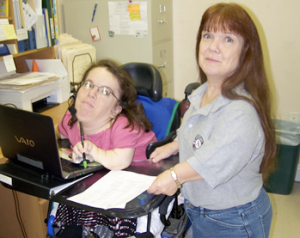
Photo of Bobbie Singletary at work, helping someone on the computer.Many AmeriCorps, Senior Corps and Learn and Serve America programs focus on emergency preparedness. Service members who serve in these programs inform and educate the public about the need for emergency preparedness, including emergency preparedness for individuals with disabilities, and respond when emergencies happen.

Bobbie Singletary is an AmeriCorps  VISTA who has been serving at Life of South Mississippi from 2006, focusing specifically on emergency preparedness for people with disabilities.

Bobbie, who is of short stature, was volunteering at Life of South Mississippi when she was asked to become their VISTA. “Life [of South Mississippi] helped my family, so I wanted to give of my time.”

In her service, she focuses on providing disaster preparedness trainings to the public and especially to persons with disabilities. She gets the word out to first responders and other emergency managers so that they are best able to assist everyone regardless Continue reading